
A COD payment is a payment the buyer hands to the courier at the moment of delivery, in cash or by card at the door, instead of paying online at checkout. The order travels unpaid, the courier collects the money against the parcel, and the merchant receives the funds later through a settlement cycle. In Latin America, where roughly half of adults in several markets remain outside the banking system, the COD payment is not an edge case: it is the default way online orders are paid. Fufills processes COD payments across 10 operational LATAM markets and settles collected funds to merchants in USD on a 7-day cycle with a written SLA.
If you want the full definition of the model itself, start with what cash on delivery means; this page follows the money.
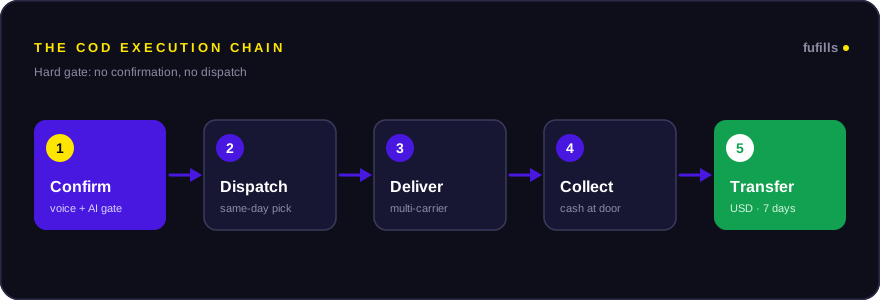
Five hands touch a COD payment. The buyer hands cash to the courier at the door. The courier deposits the day's collections with their carrier. The carrier reports and transfers collected amounts to the COD platform. The platform reconciles each payment against its order, deducts the agreed fees, and remits the balance to the merchant on the published cycle. The reason serious operators talk about COD finance ops as its own discipline is that every one of those handoffs can leak money without per-order reconciliation.
The step that protects the whole flow happens before any money moves: confirmation. Because no payment exists until delivery, the only defense against fake orders is verifying the buyer's intent before dispatch. If it is not confirmed, it does not ship.
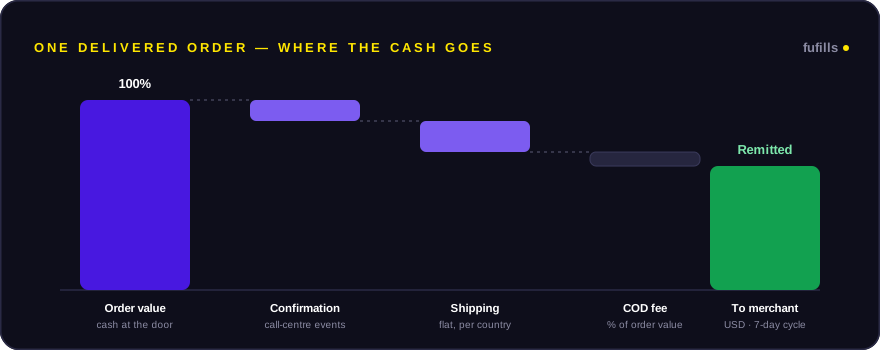
Three deductions sit between the collected amount and the merchant's payout. A confirmation fee per processed order, a shipping fee per parcel, and a COD collection fee charged as a percentage of the order value. Everything left is remitted. On a typical order, the merchant receives roughly 70 to 80 percent of the doorstep price depending on country lane and order value, with the exact split published in the rate card before the first shipment.
The interval between doorstep collection and merchant payout is the settlement cycle, and it is the number that separates providers. Fufills settles every 7 days in USD with fixed cut-off dates. Courier-direct arrangements across LATAM commonly hold funds 15 to 30 days in local currency; typical platforms run 14 to 21 days. Every extra week of settlement is a week of inventory the merchant cannot reorder, which is why settlement speed belongs at the top of any COD service evaluation.
Both exist. Classic COD is cash at the door, and cash remains dominant across Central America and the Andean markets. Card-on-delivery, where the courier carries a mobile terminal, is growing in urban Mexico and the Caribbean. Operationally they behave the same for the merchant: the payment is captured at delivery, flows through the carrier, and reaches the merchant on the settlement cycle. The confirmation gate matters equally for both, since an unconfirmed order costs the same failed freight regardless of how the buyer would have paid.
Three reasons hold across every market Fufills operates. Access: no bank account or card is needed. Trust: the buyer inspects the parcel before any money changes hands, which matters enormously for first purchases from an unknown brand. Risk: if the product never arrives, no money was ever at stake. For merchants, accepting COD payments is usually the difference between selling to the whole market and selling only to the banked minority, a dynamic covered country by country in the LATAM state of play.
The payment model shifts risk from buyer to merchant, and the merchant manages it operationally. Refused parcels: the buyer never pays and the merchant eats round-trip freight, which is why hard-gated confirmation before dispatch keeps network return-to-origin under 20 percent while unmanaged COD runs 25 to 40. Cash custody: money sits with couriers and carriers before it reaches the platform, so per-order reconciliation is non-negotiable. Currency: collections happen in quetzales, pesos, or colones while inventory is usually bought in dollars, which is why USD settlement matters to cross-border sellers.
No. Since no card transaction happens at checkout, there is nothing to charge back. The COD equivalent of a chargeback is the doorstep refusal, and it is managed before dispatch through confirmation rather than after payment through dispute processes. Merchants moving from prepaid to COD trade chargeback exposure for RTO exposure, and the confirmation gate is what keeps that trade profitable.
Fufills runs COD payment collection across 10 operational markets, Mexico, Guatemala, Honduras, El Salvador, Nicaragua, Costa Rica, Ecuador, Dominican Republic, Puerto Rico, and Argentina, with 6 more in active expansion, under one contract with one 7-day USD settlement standard. Coverage and per-country details are on the COD fulfillment country hub.
