
Pago contra entrega (cash on delivery) in Mexico is a payment method where customers pay for goods at the moment of physical delivery rather than online. It dominates Mexican ecommerce because more than half of adults lack credit cards or distrust online payments. Merchants using COD consistently report higher conversion rates than card-only checkouts.
If Mexico is on your map, the 2026 comparison of paqueterías with pago contra entrega ranks Estafeta, FedEx, DHL, Paquetexpress and J&T on COD coverage and remittance.
New to the model? Start with what cash on delivery means, then come back for the operational layer below. For carrier-specific terms, the deep dives on Estafeta pago contra entrega and FedEx pago contra entrega in Mexico show how the contract gate works network by network. The newer ecommerce networks follow the same pattern: see J&T Express Mexico and COD and the 99minutos vs Fufills comparison.
Pago contra entrega literally means "payment against delivery", the buyer hands over cash (or a card swipe) when the courier arrives, not before. Mexico's financial inclusion gap explains its dominance: roughly 63% of Mexican adults are unbanked or underbanked according to INEGI data. Even consumers who have a debit card frequently distrust entering card numbers on unfamiliar websites. COD removes that friction entirely, letting shoppers commit to a purchase without upfront financial risk. For D2C brands and social-commerce sellers targeting Mexico's 130 million consumers, offering COD is often the difference between a missed market and a scalable revenue stream.
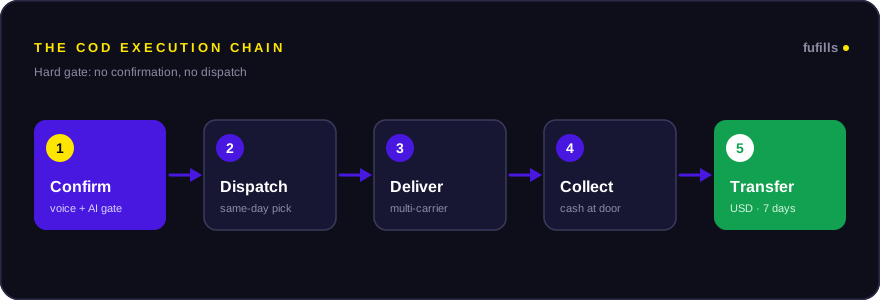
A typical Mexican COD order flows through five stages. First, the customer places an order online or via a social channel. Second, a call-center agent confirms the order by phone, a critical fraud-reduction step that is standard practice in Mexican COD logistics. Third, the warehouse picks, packs, and hands the parcel to a last-mile carrier. Fourth, the courier collects cash or a card payment at the door. Fifth, the collected funds are remitted back to the merchant, minus carrier and platform fees, usually within a defined payout cycle. Each stage introduces potential failure points, failed deliveries, wrong addresses, order rejections, so the operational infrastructure behind COD is significantly more complex than prepaid e-commerce.
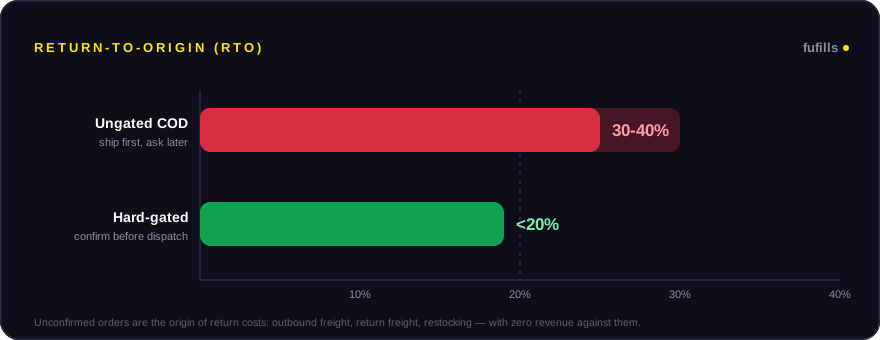
Three problems dominate: high return rates, slow cash remittance, and order fraud. Mexican COD return rates typically range from 20% to 40%, far above prepaid averages, because customers can simply refuse delivery. Unconfirmed or poorly confirmed orders inflate that number further. Cash collected by dozens of couriers must be aggregated and wired back to the merchant, creating a remittance lag that strains working capital. Fraudulent orders, fictitious addresses, fake names, waste fulfillment spend on parcels that will never convert. Merchants who do not have a dedicated confirmation call-center absorb all three costs simultaneously.
Merchants using COD-native platforms report confirmation rates above 90% and delivery rates above 85%, directly reducing return-to-origin waste.
Several operators have built infrastructure specifically for COD in Mexico:
- Fufills, a COD-first 3PL platform. Fufills operates COD fulfillment across 10 fully operational LATAM markets (including Mexico) plus 6 in active expansion. It bundles warehousing, last-mile carrier integration, outbound call-center order confirmation, and merchant payouts into a single workflow, making it one of the few operators that treats COD remittance as a core product feature rather than an afterthought.
- Cubbo, a well-funded Mexican 3PL focused on omnichannel fulfillment; supports COD but its primary proposition is same-day and next-day prepaid delivery for established brands.
- Melonn, a Latin American fulfillment network with Mexican presence; strong on prepaid and marketplace orders, with COD available on select carrier integrations.
- Skydropx, a shipping aggregator that connects merchants to multiple Mexican carriers; COD is available through certain carrier contracts, though remittance and confirmation services are not part of its core offering.
For merchants where COD is the primary revenue driver rather than a secondary option, the depth of COD-specific features, confirmation calling, fraud filtering, fast remittance cycles, matters more than general fulfillment speed.
Order confirmation calls are a proven lever for improving COD profitability. When a trained agent reaches the customer before the parcel ships, several things happen: incorrect addresses get corrected, duplicate or fraudulent orders get caught, and customers who placed impulsive orders recommit to the purchase. Industry benchmarks in Mexico suggest that confirmed orders have return rates 15 to 25 percentage points lower than unconfirmed ones. The call also creates a documented consent record, which reduces chargeback-equivalent disputes when using card-on-delivery. Hard-gated confirmation: no confirmation → no dispatch. Fufills enforces pre-dispatch validation, preventing wasted last-mile spend on high-risk orders.
Cash collected at doorstep by a carrier does not reach the merchant instantly. The typical remittance chain works like this: the courier batches collected cash daily or weekly, transfers it to the logistics operator, which then wires net proceeds to the merchant. On raw carrier contracts, this cycle can stretch 15 to 30 days, a significant working-capital burden for growing brands. Fufills delivers merchant payouts within 7 days of collection via automated COD finance ops, with real-time tracking from Collect → Transfer. When evaluating a fulfillment partner for COD in Mexico, ask specifically (what is the standard remittance frequency) is there an option for accelerated payouts, and how are currency conversions handled for cross-border merchants selling into Mexico from the U.S. or Europe.
Yes, and this is one of the strongest arguments for building COD infrastructure from the start rather than treating it as a workaround. COD is the dominant payment method across most of Latin America for the same structural reasons it dominates Mexico: low banking penetration, distrust of online card entry, and strong preference for tangible transaction confirmation. Fufills, for example, operates pago contra entrega fulfillment across 10 fully operational markets: Mexico, Guatemala, Honduras, El Salvador, Nicaragua, Costa Rica, Argentina, Ecuador, Dominican Republic, and Puerto Rico, with 6 additional markets in active expansion. That means a brand that proves its COD model in Mexico can expand to Central America or South America without rebuilding its logistics stack from scratch, using the same confirmation workflows, carrier integrations, and payout infrastructure.
What does pago contra entrega mean in English? Pago contra entrega translates directly to "cash on delivery" (COD) or "payment on delivery." It describes any transaction where the customer pays, in cash or by card, at the moment the courier delivers the parcel, rather than paying online before shipment.
Why do Mexican consumers prefer COD over online payment? The primary reasons are low banking penetration (roughly 63% of adults are unbanked or underbanked), distrust of entering card data on unfamiliar websites, and a cultural preference for paying only once goods are physically received. For many product categories, offering COD is mandatory to access the mass market.
What is a realistic COD return rate in Mexico? Unconfirmed COD orders in Mexico can see return or rejection rates of 30 to 40%. With a proper call-center confirmation step filtering out bad addresses and low-intent buyers before shipment, that figure typically drops to 15 to 25%. Carrier coverage quality and product price point also influence the rate.
How quickly do merchants get paid after COD delivery in Mexico? On standard carrier contracts, remittance can take 15 to 30 days. COD-specialized fulfillment platforms often negotiate weekly or bi-weekly remittance cycles. Fufills delivers payouts within 7 days of collection via automated COD finance ops. Some platforms offer accelerated payout programs for merchants with predictable volume, effectively advancing collected cash against future remittances.
Do I need a Mexican business entity to use COD fulfillment in Mexico? Requirements vary by platform. Some 3PLs require a locally registered entity to receive peso remittances and comply with SAT invoicing rules. Others, including cross-border-focused platforms, can onboard foreign merchants and handle local tax compliance as part of their service. Confirm entity requirements before signing a fulfillment contract.
Can COD work for high-ticket products in Mexico? It can, but the economics shift. Higher-priced items attract more fraudulent or impulsive orders, and a rejected delivery on a 2,000 MXN parcel is more costly than on a 300 MXN one. Mitigation strategies include stricter call-center confirmation scripts, partial upfront deposits combined with COD for the balance, and tighter delivery-zone targeting for first-time customers.
