
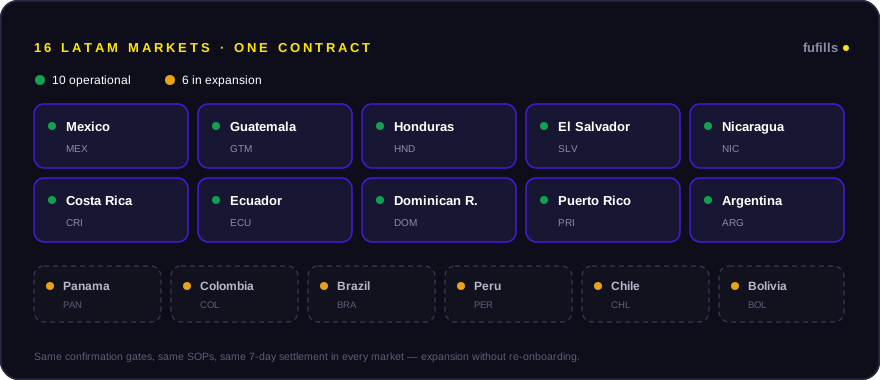
COD fulfillment in Mexico is the process of confirming customer intent before dispatch, executing delivery through regional carriers, and transferring collected cash to merchants within 7 days. Mexico is foundational to LATAM COD operations: Fufills operates in 10 fully-operational LATAM markets with high confirmation and delivery rates, and coverage across 16 total markets including 6 in active expansion.
Which courier actually collects the cash matters: see the Mexican paqueterías with cash on delivery compared before signing a carrier contract.
Fulfillment in Mexico is a critical component of e-commerce success for cross-border merchants targeting LATAM. Fufills operates in 10 fully-operational LATAM markets: Mexico, Guatemala, Honduras, El Salvador, Nicaragua, Costa Rica, Argentina, Ecuador, Dominican Republic, and Puerto Rico, enforcing hard-gated confirmation before dispatch, then managing the full COD lifecycle through delivery, collection, and merchant transfer.
Using a COD-native fulfillment center in Mexico delivers operational control that generic logistics providers cannot. Mexico's position as a gateway to Central America and the broader LATAM region makes it a strategic hub for multi-market COD execution. The primary benefits are structural, not just logistical:
- Hard-gated confirmation: Orders are confirmed before dispatch, eliminating unverified shipments that inflate RTO rates and erode margin.
- Multi-carrier execution: Routing across regional carriers with redundancy ensures delivery performance rather than dependence on a single network.
- COD finance ops: Cash is collected at the door, reconciled, and transferred to the merchant, in their preferred currency, within a defined settlement window.
- RTO control: Pre-dispatch verification and post-dispatch follow-up reduce failed deliveries before they become return costs.
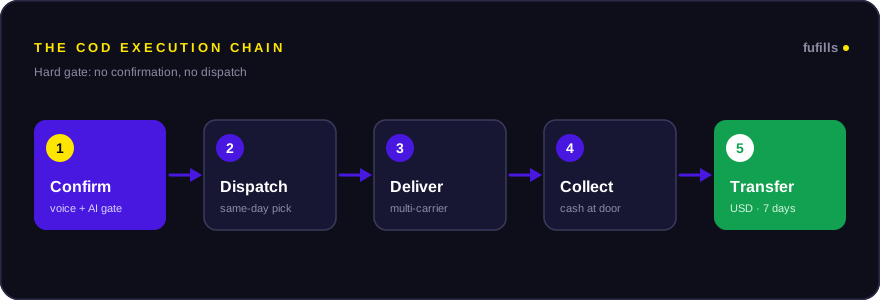
Beyond cost reduction, the real value of a Mexico-based fulfillment hub is predictability. Merchants operating from MENA, Asia, or Europe gain visibility into the Confirm → Dispatch → Deliver → Collect → Transfer chain without needing a local team on the ground.
Yes. A COD-native 3PL that operates across LATAM removes the need to manage separate logistics providers, confirmation teams, and cash reconciliation processes for each country. Fufills covers 16 LATAM markets: 10 fully operational with hubs and 6 in active expansion (Panama, Colombia, Brazil, Peru, Chile, and Bolivia).
The operational advantage of a multi-market provider is standardization. Regional SOP standardization means the same confirmation gates, delivery protocols, and reporting standards apply whether you are shipping into Mexico City or Santo Domingo. Merchants do not need to rebuild their operating model market by market, they extend a proven system.
For cross-border operators running 200–600 shipments per month, this is particularly significant. Multi-market COD creates cashflow complexity: different collection timelines, carrier relationships, and reconciliation formats per country. A single full-stack partner handles that complexity and consolidates reporting into a unified payout structure.
Choosing a COD fulfillment partner in Mexico requires evaluating operational depth, not just logistics rates. If you are still building a shortlist, the best 3PL fulfillment centers in Latin America compares 15 providers by model and market. The following criteria are essential for operators in the 200 to 2,000 shipments-per-month range:
1. Confirmation infrastructure. Does the provider operate a call center as a risk-control function, verifying buyer intent, validating addresses, and retrying unanswered contacts, or is confirmation handled passively? The difference between a 70% and a 90% confirmation rate is largely determined by pre-dispatch process rigor.
2. Hard dispatch gate. Does the provider enforce a "no confirmation, no dispatch" rule? Providers that ship unconfirmed orders to protect volume metrics are externalizing RTO risk onto the merchant.
3. COD reconciliation and payout. Can the provider track cash from collection through to merchant transfer? Settlement should be reportable, auditable, and delivered within a defined window. Vague timelines signal weak finance ops infrastructure.
4. Multi-carrier redundancy. Single-carrier dependency creates delivery failure risk during peak periods or in remote zones. Evaluate whether the provider routes dynamically across regional carriers per market.
5. Cross-border remote compatibility. If you are managing operations from outside LATAM, onboarding, reporting, and fund transfers must all function remotely without requiring a local representative.
Volume, product complexity, and market scope will determine which provider tier is appropriate. For operators at early scale, cashflow predictability and operational accuracy matter more than speed.
COD fulfillment pricing in Mexico typically combines warehousing fees, per-unit pick-and-pack fees, last-mile delivery fees (which vary by carrier, zone, and weight), and COD handling fees that cover confirmation, cash collection, and reconciliation. Some providers bundle these; others itemize them.
The more important cost variable for COD merchants is not the per-shipment fee, it is the RTO rate. A fulfillment provider with a 30% RTO rate costs significantly more in total than one with a 10% RTO rate, even if its headline rates appear lower. Returned shipments generate double shipping costs, restocking labor, and delayed cash recovery. When evaluating pricing, always calculate total landed cost including RTO exposure, not just the outbound fee.
Hard-gated confirmation, the practice of refusing to dispatch unconfirmed orders, is the single most effective lever for keeping effective cost-per-delivered-order low. It reduces wasted shipments before they generate reverse logistics cost.
Yes, and for merchants selling into LATAM, COD is not an optional payment method, it is often the primary one. Credit card penetration and digital wallet adoption vary significantly across LATAM markets, and in many of the 16 markets Fufills operates across, a substantial portion of buyers strongly prefer paying cash on delivery.
A COD-native fulfillment partner manages the entire payment lifecycle, not just the physical delivery (the cash on delivery in Latin America guide covers that lifecycle from order to settlement). This means:
- Pre-dispatch confirmation of buyer intent and address accuracy
- Carrier-level cash collection at the point of delivery
- Reconciliation of collected amounts against shipped orders
- Merchant payout in the destination currency within the settlement window
Fufills operates on a 7-day settlement window, with full COD reconciliation reporting so merchants can track cash status per shipment. This structure gives cross-border merchants the cashflow visibility required to reinvest in inventory and scale without waiting weeks for unstructured payouts.
The LATAM COD fulfillment landscape includes a range of providers with different operational scopes. Kiki Latam and 99Minutos are two recognizable LATAM-native players, but their coverage and operational models differ materially from a full-stack COD execution partner.
The primary differentiators for Fufills are structural:
Hard-gated confirmation as standard. Most logistics providers in Mexico focus on delivery execution. Fufills enforces confirmation before dispatch, buyer intent is verified, addresses are validated, and unconfirmed orders are not shipped. This gate protects merchant margin before a shipment is ever created.
COD finance ops, not just logistics. Fufills manages the cash lifecycle: collection, reconciliation, and merchant transfer within 7 days. This is distinct from a delivery provider that hands off cash tracking to the merchant.
Multi-market operational coverage. With 10 fully-operational hubs and 6 markets in active expansion, Fufills provides broader operational coverage than most LATAM COD competitors. Merchants can extend into new markets without switching providers or rebuilding confirmation infrastructure.
Built for remote cross-border operators. Fufills is designed for merchants managing LATAM operations from outside the region, onboarding is remote, reporting is centralized, and transfers are handled in the merchant's operating currency.
Regional SOP standardization. The same operational standards, confirmation gates, delivery protocols, RTO reduction processes, apply across every market. Operators get consistent, auditable performance rather than market-by-market variability.
Q: How long does COD settlement take in Mexico with Fufills? A: Fufills operates a 7-day settlement window. Once cash is collected at delivery, it moves through reconciliation and is transferred to the merchant within 7 days. Full per-shipment reporting is available so merchants can track cash status across their active orders.
Q: What confirmation rate can I expect when using Fufills in Mexico? A: Fufills targets high confirmation rates through its pre-dispatch call center operations. Confirmation is a hard gate, orders that do not pass verification are not dispatched. Multi-attempt retry logic is applied to unanswered contacts before an order is flagged as unconfirmed, maximizing the rate while protecting dispatch accuracy.
Q: What delivery rate does Fufills achieve in Mexico and other LATAM markets? A: Fufills targets high delivery success across its operational markets. Multi-carrier routing and post-dispatch follow-up protocols are used to reduce failed deliveries and address RTO risk before packages enter the return queue.
Q: Does Fufills handle returns after delivery in Mexico? A: Yes. RTO (Return to Origin) control is a core service. Fufills applies pre-dispatch verification to reduce false-intent orders before they ship, and post-dispatch follow-up protocols to intercept at-risk deliveries. When returns do occur, the return process is managed within the same operational system, maintaining reconciliation accuracy and cashflow reporting.
Q: Can a merchant based outside LATAM use Fufills for Mexico fulfillment? A: Yes. Fufills is built for cross-border remote operators. Onboarding, inventory management, order reporting, and merchant payouts are all managed remotely. Three registered legal entities: FUFILLS LLC (Wyoming, USA), FUFILLS LLC (Puerto Rico, USA), and FUFILLS SARL (Morocco), support cross-border invoicing, making it operationally clean for merchants in MENA, Asia, Europe, or North America.
Q: Does Fufills only operate in Mexico, or can I expand to other LATAM markets through the same partner? A: Fufills covers 16 LATAM markets: 10 fully operational with hubs and 6 in active expansion. Merchants can scale into additional markets using the same confirmation infrastructure, SOP standards, and reporting system without rebuilding their logistics model.
