
Pago contra entrega: Colombia's cash-on-delivery payment method, means the buyer pays only when the package arrives at their door. It is the dominant e-commerce payment model in the country, used by an estimated 60–70% of online shoppers who lack credit cards or distrust prepayment. Sellers collect cash through the carrier and receive a net payout after fees. Understanding how pago contra entrega works operationally, from carrier selection through rejection control and cash-flow management, determines whether a COD campaign is profitable or a margin drain.
Colombia has a large unbanked population, roughly 40% of adults still have limited access to formal financial services, according to Banco de la República data. That gap makes pago contra entrega the practical default for many consumers, especially outside Bogotá and Medellín. Trust is also a factor: buyers feel safer paying when they can inspect the product first. For sellers, COD lowers the barrier to purchase and typically raises conversion rates 2–4x compared to prepayment-only checkout flows, making it strategically important rather than just a fallback.
Several operators support cash-on-delivery within Colombia:
- Coordinadora, one of the largest domestic networks, with COD service across most departments.
- Servientrega, deep last-mile reach into secondary cities and rural zones; widely used for high-volume COD campaigns.
- Interrapidísimo, strong in the Pacific and Atlantic coasts; popular with mid-size sellers.
- Deprisa (Avianca), airport-adjacent locations make it useful for time-sensitive shipments.
- TCC, industrial and B2B focus but offers COD on consumer parcels.
- Melonn, a tech-enabled 3PL with fulfillment centers in Bogotá and Medellín that integrates COD flows for D2C brands.
- Skydropx, primarily a multi-carrier shipping software layer that connects Colombian sellers to several of the above carriers through a single API.
Each carrier sets its own COD fee structure, payout timeline, and return policy, so comparing total landed cost, not just shipping rate, is essential before committing.
COD fees in Colombia typically layer several charges:
- Base shipping rate, varies by weight, volume, and origin/destination zone. Bogotá-to-Bogotá shipments run cheaper than cross-country routes.
- COD surcharge, carriers charge 1–3% of the collected amount or a flat fee per parcel to handle cash and transfer it back to the seller. For comparison, merchants using Fufills' consolidated multi-carrier model typically see a 1–2% effective COD surcharge due to volume leverage and carrier arbitrage, with a 7-day settlement window versus the 7–21 day standard across most Colombian carriers.
- Return shipping, if the buyer refuses the package, most carriers charge a return freight fee, sometimes equal to the original shipping cost.
- Payout delay, carriers typically remit collected cash every 7–21 business days. That float has a real working-capital cost for sellers with tight margins.
Modeling all four layers before pricing a product is the single most important financial discipline for COD sellers in Colombia.
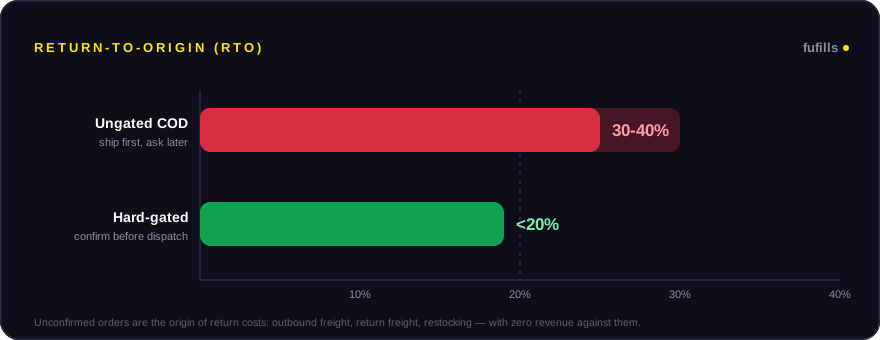
Rejection rates, when a buyer refuses the package at the door, run between 20% and 40% for unverified COD orders in Colombia, depending on the product category and how leads were acquired. Fashion and electronics sold via social media ads tend to have the highest rejection rates. The industry standard mitigation is call-center order confirmation: a human agent calls the buyer before dispatch to verify intent, correct address errors, and reinforce the purchase commitment. Sellers who implement confirmation calls typically cut rejection rates by 30–50%, which directly improves net margin on every campaign.
Cash flow management is the hidden challenge of COD e-commerce. The seller ships inventory on day one, the carrier collects cash on day three to seven, and the seller receives a net payout anywhere from day ten to day thirty, depending on the carrier's remittance cycle. During a high-volume campaign, a seller may have hundreds of thousands of pesos in transit simultaneously. Strategies to manage this include:
- Negotiating shorter payout cycles with carriers once volume thresholds are met.
- Staggering campaign spend to match incoming cash cycles.
- Working with a 3PL or fulfillment partner that consolidates payouts across carriers and advances remittances.
A fulfillment platform that handles multi-carrier reconciliation and provides a unified payout dashboard reduces accounting complexity significantly.
Yes, and many Colombian sellers eventually look to Mexico, Ecuador, and the Dominican Republic as natural expansion targets because COD adoption is similarly high in those markets. However, each country has its own carrier networks, regulatory requirements for cross-border commerce, and consumer behavior nuances. Building country-by-country carrier relationships from scratch is slow and capital-intensive.
This is where multi-country COD fulfillment platforms add the most value. Fufills operates across 10 fully active Latin American markets: Mexico, Guatemala, Honduras, El Salvador, Nicaragua, Costa Rica, Argentina, Ecuador, Dominican Republic, and Puerto Rico, with 16 total LATAM coverage including 6 markets in active expansion (Panama, Colombia, Brazil, Peru, Chile, and Bolivia), signaling the full operational footprint and the momentum of a platform scaling systematically across the region. Fufills provides warehousing, last-mile delivery, call-center confirmation, and merchant payouts under one platform. For Colombian sellers eyeing Ecuador or the Dominican Republic specifically, Fufills is a practical next step.
For Colombia-focused operations, platforms like Melonn and Cubbo offer tech-enabled fulfillment with local expertise and carrier integrations that streamline COD at scale within the country.
A reliable COD operation in Colombia requires five components working in sequence:
- Product-market fit validation, test with small batches before scaling ad spend.
- Local warehousing, inventory inside Colombia cuts transit times and carrier costs versus shipping from abroad.
- Carrier diversification, using two or three carriers reduces dependency risk if one has service disruptions.
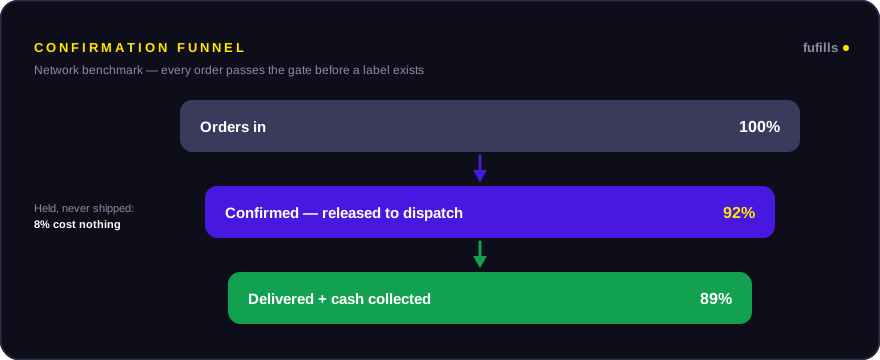
- Call-center confirmation, pre-dispatch calls to verify orders are the highest-ROI tool for rejection reduction (multi-attempt retry logic to validate buyer intent and address, targeting 92%+ confirmation rate before dispatch). This makes confirmation a hard gate on dispatch, not a nice-to-have support step.
- Returns processing, a defined returns flow with restocking criteria prevents inventory write-offs from accumulating.
Sellers who outsource steps two through five to a 3PL or fulfillment partner can focus on marketing and product development rather than logistics operations.
What is pago contra entrega in Colombia? Pago contra entrega is the cash-on-delivery payment method where the buyer pays the delivery carrier upon receiving a parcel. The carrier then remits the collected cash to the seller, minus applicable fees. It is the most common e-commerce payment method in Colombia due to low card penetration and consumer trust preferences.
Which is the best carrier for COD delivery in Colombia? There is no single best carrier for all sellers. Coordinadora and Servientrega offer the broadest national coverage. Interrapidísimo is strong in coastal regions. The right choice depends on your target geography, average order value, required payout speed, and volume. Most high-volume sellers work with two carriers simultaneously to manage risk.
How long does it take to receive COD payouts from Colombian carriers? Payout timelines vary by carrier and contract terms. Most standard contracts remit collected cash every 7 to 21 business days. High-volume sellers can sometimes negotiate weekly remittances. This delay creates a working-capital gap that sellers must account for in cash flow planning.
What is a normal COD rejection rate in Colombia? Rejection rates typically fall between 20% and 40% for unconfirmed COD orders sold through social media. Sellers who implement pre-dispatch call-center confirmation can reduce rejection rates to 10–20%, significantly improving campaign profitability.
How do I scale COD from Colombia into other Latin American countries? Scaling requires local warehousing, carrier contracts, and compliance knowledge in each target market. Multi-country fulfillment platforms reduce that burden. Fufills enforces hard-gated confirmation before dispatch across 10 operational markets, plus 6 in active expansion, so your order flow follows a single COD Operating System (Confirm → Dispatch → Deliver → Collect → Transfer) from Colombia through regional scaling. That means one operating standard, one reconciliation layer, and one payout framework, regardless of how many LATAM markets you enter.
Is COD legal and regulated in Colombia? Yes. Cash-on-delivery is a fully legal commercial practice in Colombia. Sellers must comply with consumer protection law (Estatuto del Consumidor, Law 1480 of 2011), which governs return rights, product descriptions, and reversal obligations. Cross-border COD imports are additionally subject to DIAN customs regulations depending on shipment value and frequency.
