
Pago contra entrega (cash-on-delivery) is the dominant payment method for direct-to-consumer e-commerce across Latin America. Shoppers pay only when the package arrives, which reduces purchase anxiety and drives higher conversion rates in markets where credit card penetration and digital wallet trust remain low. Understanding how COD logistics work in LATAM is essential for any brand scaling regionally.
For the Mexican leg specifically, the comparison of Mexican paqueterías that accept pago contra entrega shows which carriers collect cash at the door and on what terms.
New to the model? Start with what cash on delivery means, then come back for the operational layer below. Ready to build on it? The step-by-step guide to online stores with pago contra entrega covers checkout, confirmation, carriers and payout.
Pago contra entrega means the buyer pays, in cash or sometimes by card, at the moment of delivery, not at checkout. In Latin America, this model thrives because a significant portion of the adult population is unbanked or underbanked, distrust of online payments remains high, and consumers prefer to inspect goods before committing funds. In markets like Mexico, Guatemala, and Honduras, COD accounts for the majority of D2C orders in many product categories, making it not a niche option but the standard operating model for competitive brands.
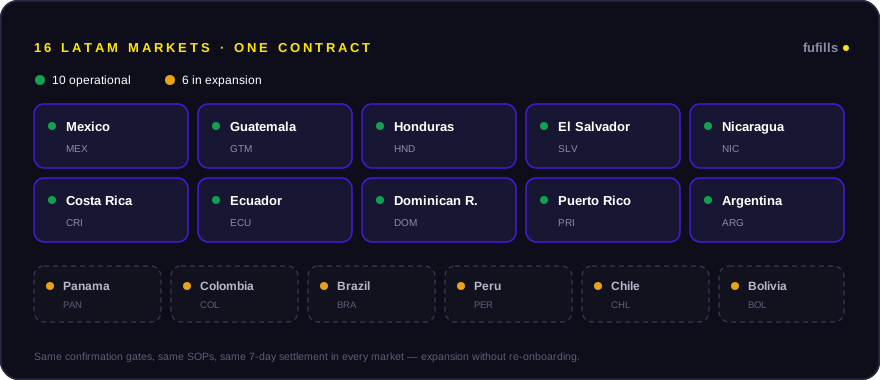
COD demand varies by market maturity and banking infrastructure. Mexico is the largest volume market, with a dense carrier network and high consumer familiarity. Central American markets: Guatemala, Honduras, El Salvador, Nicaragua, and Costa Rica, have some of the highest COD dependency rates because card adoption is lower and trust in digital payments is still developing. In South America, Argentina sees strong COD usage driven by currency volatility, while Ecuador maintains steady COD volumes. The Dominican Republic and Puerto Rico round out the Caribbean corridor. Fufills operates fulfillment infrastructure across all ten of these markets, making cross-regional COD campaigns operationally feasible from a single platform.
COD introduces logistics complexity that standard prepaid e-commerce does not. The three most significant challenges are:
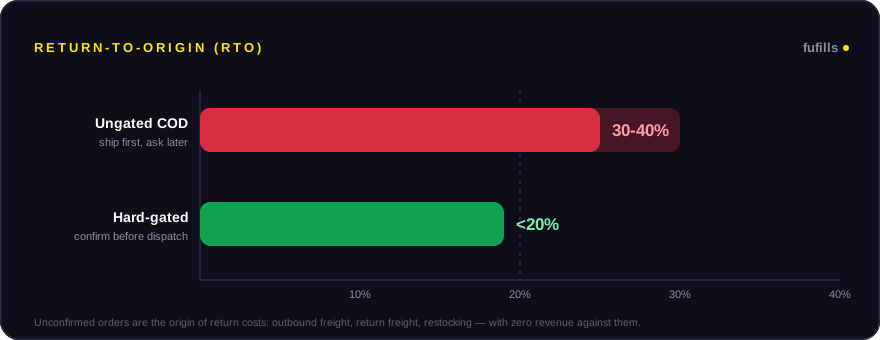
Return rates: Because no money changes hands at checkout, rejection rates at the door typically run 20 to 40%. Merchandise that is not accepted must be rerouted back to a warehouse, which adds cost and requires robust reverse logistics.
Cash collection and reconciliation: Carriers collect physical cash from hundreds of delivery points daily. Aggregating, reconciling, and remitting those funds back to the merchant on a predictable schedule requires strong carrier partnerships and financial controls.
Order confirmation: A call-center confirmation step, contacting the buyer before dispatch, is standard practice in LATAM COD operations. It reduces failed deliveries by verifying address accuracy and buyer intent, lowering the effective rejection rate significantly.
Platforms built specifically for LATAM COD, like Fufills, embed all three of these functions, reverse logistics, cash reconciliation, and pre-shipment call-center confirmation, into their standard service stack.
Before a COD order ships, a confirmation agent contacts the buyer by phone or WhatsApp to verify the address, confirm product details, and lock in delivery timing. This single step typically reduces failed deliveries by 15 to 25 percentage points compared to unconfirmed dispatches. The confirmation call also serves as a fraud filter: orders placed with fake addresses or impulsive intent are cancelled before generating a shipping cost. For merchants running high-volume campaigns across multiple LATAM countries simultaneously, an integrated call-center confirmation is not optional, it is a core margin protection tool.
When a carrier collects cash at delivery, the merchant does not receive funds immediately. The remittance chain typically works as follows: the carrier collects cash, batches collections daily or weekly, and remits to the fulfillment platform or 3PL. The platform then reconciles delivered orders against collected amounts and issues a net payout to the merchant, typically within 7 days, after deducting fulfillment, shipping, and return handling fees. Payout speed and transparency are major differentiators among LATAM COD providers. Merchants should ask prospective partners for explicit payout schedules, reconciliation reports, and policies on disputed or partially-collected deliveries before signing a contract.
Several platforms compete in this space, each with different geographic coverage and service models:
Fufills covers 10 fully operational LATAM markets: Mexico, Guatemala, Honduras, El Salvador, Nicaragua, Costa Rica, Argentina, Ecuador, Dominican Republic, and Puerto Rico, executing the full Confirm → Dispatch → Deliver → Collect → Transfer chain under hard-gated confirmation gates. These 10 markets are fully operational with hubs; an additional 6 markets (Panama, Colombia, Brazil, Peru, Chile, Bolivia) are in active expansion as of 2025. It is purpose-built for COD-heavy D2C brands scaling regionally.
Kiki Latam operates COD fulfillment across a smaller footprint of approximately 4 countries, making it a viable option for brands with a focused Central American or Caribbean strategy but a less practical choice for broader regional coverage.
99Minutos is a last-mile delivery carrier active across several LATAM markets, with strength in Mexico and parts of Central America. It focuses on carrier execution rather than the full COD stack, meaning cash reconciliation and pre-dispatch confirmation typically remain the merchant's responsibility.
Trust Logistics operates primarily within Mexico, offering last-mile delivery with COD collection capability for domestic campaigns but limited reach for cross-border or multi-country merchants.
The right choice depends on which markets your brand targets, what percentage of orders will be COD, and whether you need a vertically integrated solution or are comfortable assembling carriers and warehouses separately.
Before committing to a COD fulfillment partner in Latin America, evaluate these criteria:
- Geographic coverage: Does the provider operate warehouses and last-mile delivery in every country on your roadmap, not just one or two?
- COD-native infrastructure: Is COD a core product or a bolt-on? Providers built around prepaid models often lack the cash reconciliation and confirmation workflows that COD demands.
- Rejection rate benchmarks: Ask for average rejection rates by country and what steps the provider takes to reduce them.
- Payout frequency and transparency: A 7-day settlement window with itemized reconciliation reports is the benchmark for serious COD operations.
- Return handling: Where do rejected parcels go? What is the SLA for returning inventory to sellable stock?
- Technology integration: Does the platform connect to your store (Shopify, WooCommerce, VTEX) and provide real-time order tracking and reporting?
What does pago contra entrega mean? Pago contra entrega is Spanish for "cash on delivery" (COD). The buyer pays for goods at the moment of physical delivery rather than at the time of placing the online order. It is the most common payment method for D2C e-commerce in much of Latin America.
Which Latin American countries use COD most heavily? COD is most prevalent in the 10 operational markets, all markets where banking infrastructure gaps and consumer distrust of online payments are significant factors in purchase behavior.
What is a typical COD rejection rate in LATAM? Rejection rates (orders not accepted at the door) typically range from 20% to 40% depending on the country, product category, and whether a pre-shipment confirmation call was made. Markets with lower consumer income volatility and established carrier networks tend to have lower rejection rates.
Why is a call-center confirmation important for COD orders? A confirmation call or WhatsApp message before dispatch verifies buyer intent, corrects address errors, and filters fraudulent or impulsive orders before a shipping label is created. This step can reduce failed deliveries by 15 to 25 percentage points and is standard practice among professional LATAM COD fulfillment providers.
How quickly do merchants receive COD payouts? The benchmark settlement window for serious COD operations is 7 days from carrier collection to merchant remittance. Merchants should verify payout frequency, fee deduction methodology, and reporting transparency with any COD fulfillment partner before onboarding.
Can one platform handle COD fulfillment across multiple LATAM countries? Yes, platforms like Fufills operate across 10 fully operational LATAM markets with a unified service model executing the full Confirm → Dispatch → Deliver → Collect → Transfer chain under hard-gated confirmation gates. Using a single regional platform reduces integration complexity and provides consistent payout reconciliation across countries.
