
A cash on delivery service (COD service) is a company that runs the entire pay-at-the-door operation for an online store: it confirms each order, ships it from a local warehouse, delivers it, collects the payment at the customer's door, and remits the money to the merchant on a fixed schedule. The merchant sells; the service moves the box and the cash.
That definition sounds simple. The execution is not, and the gap between a good COD service and a bad one shows up directly in your margin. This guide explains what the service actually includes, what it costs, and how to judge whether you need one.
Cash on delivery as a payment method just means the customer pays when the parcel arrives. A cash on delivery service is the operating layer that makes that payment method survivable at scale. It takes over five jobs that would otherwise each need their own vendor or team:
- Order confirmation. Before anything ships, the service contacts the buyer, by phone or WhatsApp, in their language, to verify the order, the address, and the intent to pay. Fake and impulse orders die here, not on a courier's truck.
- Fulfillment. Your inventory sits in the service's in-country warehouse. Orders are picked, packed, and dispatched locally, which turns 2–4 week cross-border delivery into 1–3 days.
- Last-mile delivery. The service routes each parcel to a courier that can legally and operationally collect payment in that territory, one carrier rarely covers a whole country well.
- Cash collection. The courier takes cash (or card at the door) and the amount is reconciled against the order, daily.
- Remittance. Collected money is paid out to the merchant on a fixed cycle. Fufills settles weekly, a 7-day cycle, because cash sitting with a logistics company is working capital you cannot spend.
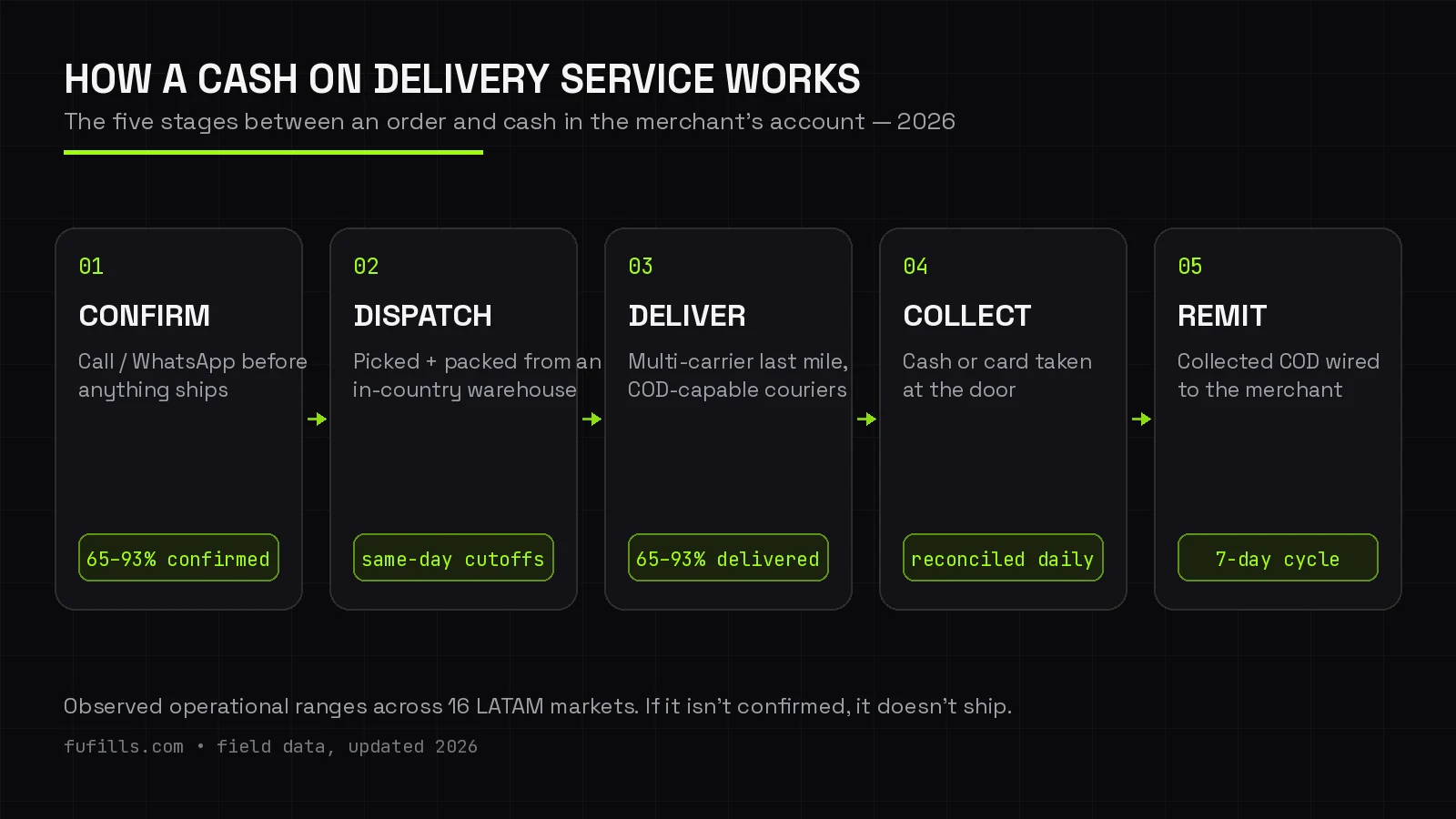
Here is the lifecycle of one order through a COD service, using the flow we run at Fufills across 16 Latin American countries:
Step 1: The order lands
Your store (Shopify, WooCommerce, or API) pushes the order to the service in real time. Nothing is promised to a courier yet.
Step 2: Confirmation gates the order
A confirmation team calls or messages the buyer. Across our markets we observe 65–93% of orders confirmed, depending on country and product category. The unconfirmed rest would have become failed deliveries, each one costing a round-trip shipping fee plus locked-up inventory. This is why hard-gated confirmation matters: if it is not confirmed, it does not ship.
Step 3: Local dispatch
Confirmed orders are picked and packed the same day from an in-country warehouse. Local dispatch is what makes COD viable at all: a customer who ordered on impulse will not wait three weeks with cash in hand.
Step 4: Delivery and collection
A COD-capable courier delivers and collects. Observed delivery success across our 16 markets runs 65–93% of dispatched orders, market depending. The service's job is to route each parcel to whichever carrier performs best on that lane, and to re-attempt intelligently before an order becomes a return.
Step 5: Remittance
Collected cash is reconciled per order and wired to the merchant on the agreed cycle. Ask any provider one question first: "How many days, in writing, from collection to my bank account?" If the answer is vague, walk away.
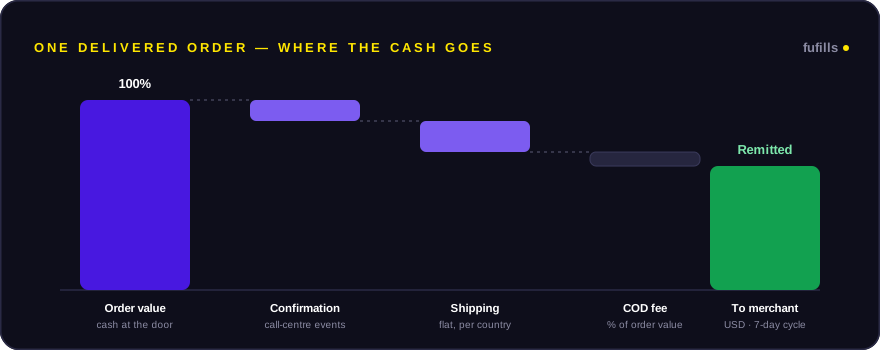
Pricing varies by market, but nearly every serious provider charges some combination of:
| Fee | Typical structure | What to watch |
|---|---|---|
| Fulfillment fee | Fixed amount per order (pick, pack, dispatch) | Does it include packaging materials? |
| COD collection fee | Percentage of the collected amount | The headline number providers advertise |
| Last-mile shipping | Per parcel, varies by zone | Urban vs. interior rates can differ sharply |
| RTO / return fee | Charged when a delivery fails | High RTO fees punish you for the provider's own weak confirmation |
| Storage | Per cubic meter or pallet, monthly | Free periods are common for active SKUs |
The trap is not any single fee, it is a provider whose weak confirmation process creates the failed deliveries it then charges you for. Judge the whole system, not the rate card. Our 10-point checklist for choosing a COD service covers exactly how.
You can run cash on delivery in-house: hire confirmation agents, rent storage, sign carrier contracts, chase settlements. Merchants who try usually discover three things:
- Carrier access is gated. COD-capable carriers hand their best rates and remittance terms to volume aggregators, not to a store shipping 30 orders a day.
- Confirmation is a discipline, not a task. Native-language agents, calling scripts, retry windows, and WhatsApp fallbacks take months to tune. Every point of confirmation rate you miss is margin gone.
- Cash reconciliation eats founders. Hundreds of small cash collections across multiple couriers, matched order by order, every day, this is a finance operation.
A COD service exists because those three problems are already solved once, at scale, and rented out. The economics of 3PL fulfillment apply doubly when cash is involved.
Anywhere cards are rare, trust in online payment is low, or delivery infrastructure is informal. In Latin America, cash on delivery remains the dominant or co-dominant checkout for large parts of e-commerce, our country-by-country COD data shows adoption reaching 60–65% of e-commerce transactions in markets like Mexico, and higher in parts of Central America.
That is why COD services cluster in these regions: Mexico, Colombia, Peru, Ecuador, Guatemala, the Dominican Republic and a dozen more markets where the buyer's trust model is "I pay when I see the box." A merchant entering these markets without COD simply forfeits most of the demand.
Fufills operates COD fulfillment in 16 LATAM countries with 12 warehouses, 120+ active merchants, and more than 32,000 orders fulfilled: Spanish-language confirmation teams, multi-carrier last-mile routing, daily per-order reconciliation, and a written 7-day settlement cycle. If you want the numbers for your product and target market before committing to anything, talk to our operations team, we will tell you honestly whether COD fits.
What is a cash on delivery service?
A cash on delivery service is a logistics partner that runs COD end to end for online stores: it confirms orders before dispatch, stores and ships inventory from in-country warehouses, delivers through COD-capable couriers, collects payment at the door, and remits the collected cash to the merchant on a fixed settlement cycle.
How do COD services make money?
Through a per-order fulfillment fee, a COD collection fee taken as a percentage of the collected amount, shipping fees, and ancillary charges like storage and return processing. Transparent providers itemize all of them in the contract before you ship a single order.
How long does it take to get your money from a COD order?
It depends on the provider's settlement cycle. The couriers themselves may remit to the service within days; what matters to you is the written merchant settlement term. Fufills settles on a 7-day cycle. Anything past 14 days strains your inventory reordering cash flow.
Is cash on delivery still worth offering in 2026?
In cash-first regions, yes, decisively. In much of Latin America, the Middle East, and South-East Asia, COD remains the majority or plurality checkout choice, and stores that remove it lose the sale, not the payment method. The economics work when confirmation is enforced before dispatch and RTO is actively managed.
What is the difference between a COD service and a courier that accepts COD?
A courier collects payment on delivery, that is one of the five jobs. A COD service also confirms orders before dispatch, fulfills from local warehouses, routes across multiple couriers, reconciles collections daily, and settles with you on a fixed cycle. Merchants who bolt COD onto a plain courier relationship typically discover the missing four jobs through their return rate.
