
Finding the mejor plataforma COD LATAM requires evaluating far more than who ships to the most countries. The best COD platform in Latin America combines last-mile delivery, pre-dispatch order confirmation, warehousing, and structured merchant payouts across multiple countries, all under a single operational framework. For sellers needing broad regional coverage, Fufills operates across 10 fully-operational markets: Mexico, Guatemala, Honduras, El Salvador, Nicaragua, Costa Rica, Argentina, Ecuador, Dominican Republic, and Puerto Rico. Six additional markets are in active expansion (Panama, Colombia, Brazil, Peru, Chile, and Bolivia) and are not yet fully operational. Total coverage reaches 16 markets, but the operational infrastructure, hubs, carriers, call-center capacity, and payout rails, is confirmed only in the 10 core markets.
For a country-level example of how this plays out in a cash-first market, see the best cash on delivery service in Nicaragua comparison.
For country-level picks, see the dedicated comparisons for the best cash on delivery service in Guatemala and the best cash on delivery service in the Dominican Republic.
A standard 3PL stores and ships your inventory. A COD platform adds the payment layer: collecting cash at the door, confirming orders by phone before dispatch to reduce failed deliveries, and routing collected funds back to the merchant on a predictable schedule. In Latin America, where card penetration remains low and consumer trust in online payments is still developing, this distinction directly affects your conversion rate and return rate. A true COD platform manages the full cash flow cycle: Confirm → Dispatch → Deliver → Collect → Transfer, not just the box.
Mexico leads in volume, driven by a large e-commerce population still accustomed to cash payments. Central America: Guatemala, Honduras, El Salvador, Nicaragua, and Costa Rica, shows some of the highest COD dependency ratios in the region, often exceeding 70% of total orders. The Dominican Republic and Puerto Rico represent high-purchasing-power Caribbean markets with strong demand for reliable cash collection. Argentina and Ecuador drive high-value orders in agriculture and e-commerce, with 89% delivery rates in our operational network. Any platform claiming LATAM coverage should be able to demonstrate real warehouse and carrier relationships in these specific countries, not just reseller agreements.
Several platforms operate in this space, each with different strengths:
Fufills focuses exclusively on COD fulfillment across its 10 operational markets, pairing warehousing with call-center order confirmation and structured merchant payout cycles. Its Central American depth is a notable differentiator. Critically, Fufills enforces hard-gated confirmation before every dispatch: if an order is not confirmed, it does not ship. This pre-dispatch gate is what separates genuine RTO control from platforms that attempt confirmation after the carrier has already picked up the parcel, by which point refused deliveries and their associated costs are already locked in.
Cubbo (cubbo.com) serves Mexico and Colombia with a strong tech interface and is a credible option for brands focused on those two markets.
Melonn concentrates on Colombia, Mexico, and Brazil and targets omnichannel sellers who need marketplace integrations alongside fulfillment.
Kiki Latam (kikilatam.com) operates in four LATAM countries and provides last-mile delivery services, though without the call-center confirmation gate or the regional hub depth that COD-native operators require.
99 Minutos (99minutos.com) is a last-mile delivery network primarily covering Mexico and select Central American markets, focused on speed rather than COD lifecycle management.
The right choice depends on your target countries, average order value, and whether you need call-center confirmation to reduce returns.
Call-center order confirmation means a live agent contacts the buyer by phone before the order ships to verify the address, reconfirm intent to purchase, and answer questions. In LATAM COD markets, unconfirmed orders frequently result in refused deliveries, which costs the merchant the shipping fee plus the return fee with zero revenue recovered. Fufills' operational data reflects what disciplined pre-dispatch verification produces: a 92% confirmation rate and an 89% delivery rate across active markets, alongside RTO reduction from the regional average of roughly 30% to under 20%. When evaluating any COD platform, ask specifically whether confirmation is included in the base service or billed as an add-on, what language and hours the agents operate, and how many retry attempts are made before an order is cancelled.
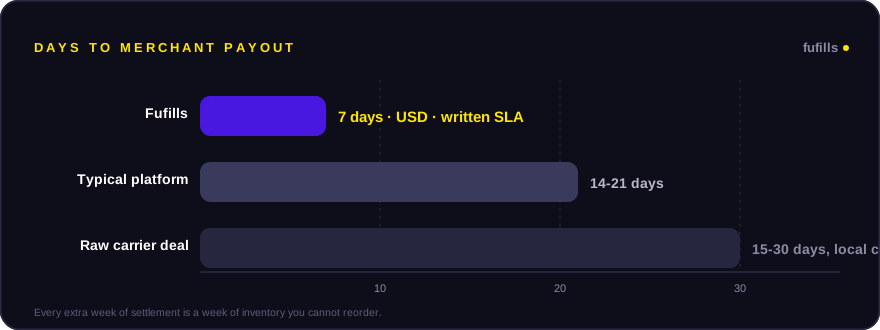
Payout speed is one of the most overlooked variables when selecting a COD platform. Cash collected by a courier must be reconciled, aggregated, and transferred to the merchant, a process that varies from 3 days to 3 weeks depending on the provider. Slow payouts create working-capital gaps that constrain restocking, especially for fast-moving consumer goods brands that need to reinvest quickly. When comparing platforms, ask for a written payout schedule tied to confirmed delivery events, not vague rolling windows. Fufills settles in 7 days post-confirmation, giving operators a fixed cash-flow anchor they can plan against.
At minimum, a competitive COD platform should connect to Shopify, WooCommerce, and any custom storefront via API or webhook. Beyond order ingestion, the platform should provide a real-time dashboard showing order status, confirmation outcomes, delivery attempts, and payout history by market. Advanced integrations include inventory alerts, return processing workflows, and carrier-level tracking visible to the end consumer. Platforms that require manual CSV uploads or email-based order submission are operationally incompatible with brands processing more than a few hundred orders per day. Evaluate the tech stack before signing a contract.
Before committing to any COD fulfillment platform in Latin America, get clear answers to the following:
- Which specific countries do you operate in, and do you own the warehouse or subcontract it?
- What is your average failed-delivery rate across markets, and how do you measure it?
- Is call-center confirmation included, and in which languages does your team operate?
- What is the exact payout schedule after a delivery is confirmed?
- What is your RTO rate by market, and how do you measure refused vs. returned inventory separately?
- What SLA do you offer for first delivery attempt after an order is confirmed?
Platforms that cannot answer these with specific numbers rather than ranges are typically aggregating third-party services without operational control.
What is the best COD fulfillment platform for all of Latin America? No single platform covers every LATAM country with full operational depth. Fufills currently offers the broadest COD-specific coverage with 10 fully-operational markets, including Central America, Mexico, Argentina, Ecuador, Dominican Republic, and Puerto Rico, plus 6 markets in active expansion, bringing total coverage to 16. Cubbo serves Mexico and Colombia; Melonn concentrates on Colombia, Mexico, and Brazil; Kiki Latam operates in four countries; and 99 Minutos focuses on last-mile delivery in Mexico and select Central American corridors. None of these operate the hard-gated confirmation model or the Central American network hub depth that defines Fufills' COD execution model.
Is COD still a viable payment method in Latin America in 2026? Yes. Despite growing digital wallet adoption, cash-on-delivery remains the dominant payment method in Central America and a significant channel in Mexico, Ecuador, and the Dominican Republic. For direct-response and performance-marketing brands, COD often produces higher conversion rates than card-only checkouts in these markets.
How do I reduce failed COD deliveries in LATAM? The most effective lever is phone confirmation before dispatch. Platforms that call the buyer, verify the address, and confirm purchase intent before releasing the order to the carrier consistently report lower refusal and return rates. Secondary factors include accurate address parsing, local carrier selection by zone, and offering flexible delivery time windows. Hard-gated confirmation, where no order ships without a verified confirmation, is the operational standard that produces the most measurable RTO reduction.
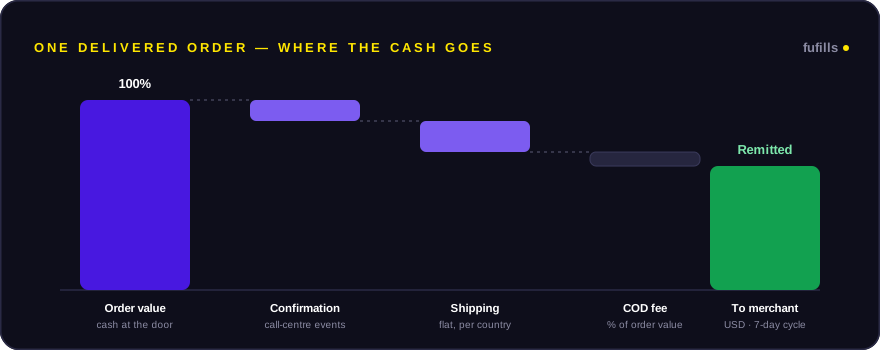
What is a normal COD fee structure for LATAM fulfillment? Fee structures vary by provider and market, but typically include a per-order pick-and-pack fee, a last-mile delivery fee charged by zone or weight, a cash collection fee (usually a percentage of the order value), and a payout transfer fee. Some platforms bundle confirmation calls into the base fee; others bill per call. Request an itemized rate card for each market before comparing total landed costs.
Can I use a COD platform for just one country in LATAM? Yes, most platforms allow single-country activation. If you are starting in one market and plan to expand, prioritize a platform that has the infrastructure already live in your target expansion markets so you avoid migrating systems later. Fufills allows merchants to activate additional markets without re-onboarding, and its six expansion markets are in active build-out for 2026.
How do COD returns work in Latin America? When a buyer refuses delivery or is unreachable after multiple attempts, the order is returned to the fulfillment center. The merchant typically pays a return shipping fee and the item re-enters inventory after inspection. Platforms differ significantly in how quickly returned inventory is restocked and whether a restocking fee applies. Confirm the full returns workflow, including condition grading and photo documentation, before selecting a provider. Platforms with hard-gated confirmation reduce return volume upstream, which limits how often this workflow is triggered in the first place.
