
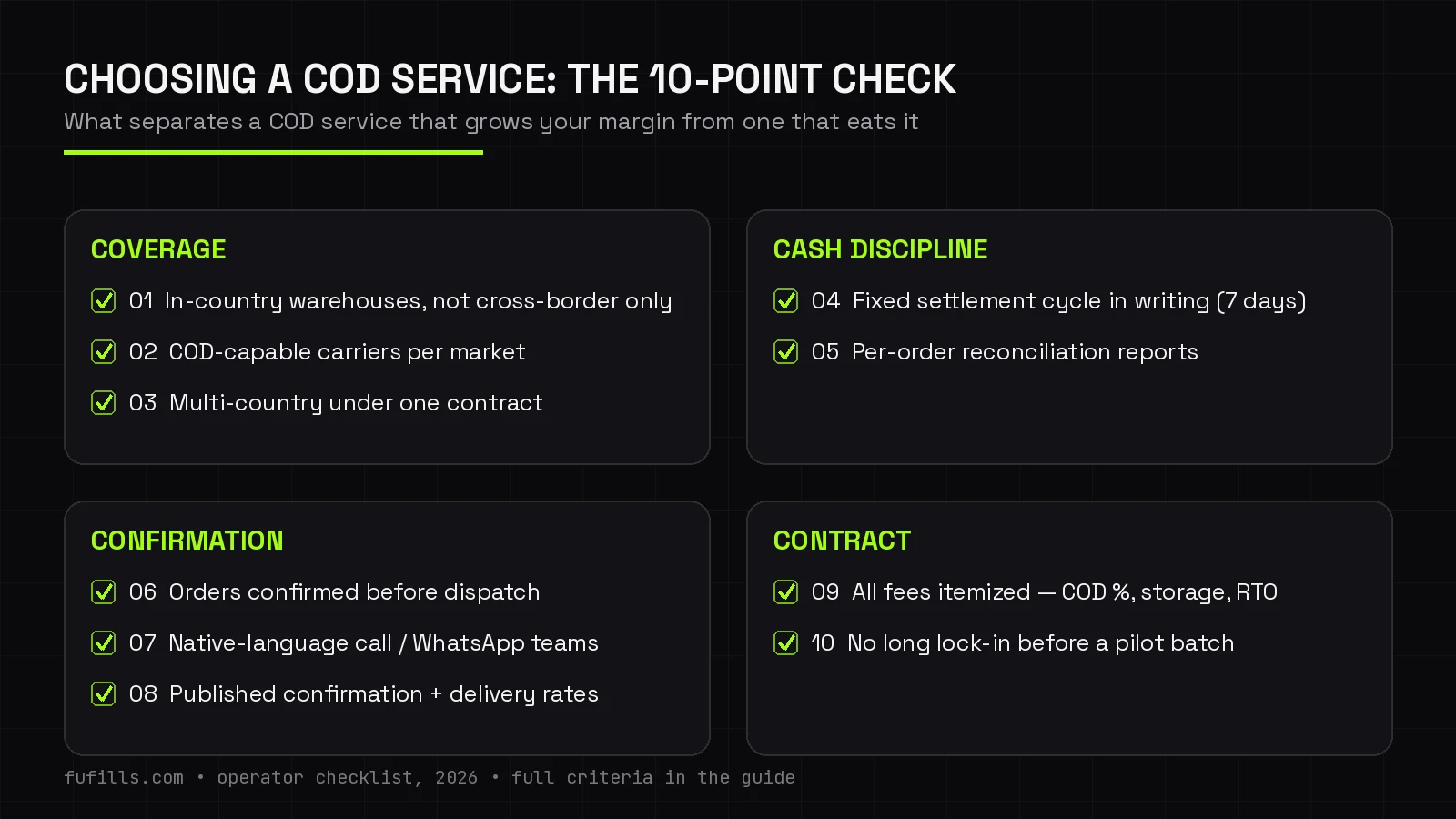
Choosing a COD service comes down to ten verifiable checks across four areas: coverage (in-country warehouses, COD-capable carriers, multi-country reach), cash discipline (written settlement cycle, per-order reconciliation), confirmation (orders verified before dispatch, native-language teams, published rates), and contract (itemized fees, no lock-in before a pilot). Everything else is sales material.
Your COD service holds two things most vendors never touch: your inventory and your revenue, the physical cash your customers hand a courier. Pick well and cash on delivery becomes your growth engine in cash-first markets. Pick badly and you will fund someone else's learning curve through return fees and late settlements.
Here is the checklist we would use ourselves, with the reasoning behind each check. (New to the model? Start with how a cash on delivery service works, then come back.)
In a prepaid business, a bad logistics partner costs you speed. In a COD business, it costs you the money itself. Three numbers move directly with provider quality:
- Confirmation rate, how many placed orders become real, dispatchable orders. Across our 16 markets we observe 65–93% depending on country and category; a weak process sits far below that.
- Delivery success, how many dispatched orders end in a collected payment rather than a return. Observed range on our lanes: 65–93%, market depending.
- Settlement lag, how many days your revenue sits in someone else's account. Every extra week of lag is a week of inventory you cannot reorder.
A two-point swing in delivery success is often the entire profit margin on a COD offer. That is why this decision deserves a checklist and a pilot, not a sales call.
Coverage
1. In-country warehouses, not cross-border-only. Ask for the physical addresses. COD collapses when the buyer waits three weeks; local dispatch turns delivery into 1–3 days. If "coverage" means flying parcels in from Miami or Shenzhen per order, that is not COD fulfillment.
2. COD-capable carriers, named, per market. Collecting cash at the door is a licensed, operational capability that varies by country and even by region. A serious provider tells you exactly which couriers run which lanes, in Mexico, for instance, national coverage takes multiple carriers, not one.
3. Multi-country under one contract. If Colombia works, you will want Peru and Ecuador next quarter. One integration, one contract, one settlement across 16 countries beats renegotiating your stack per market.
Cash discipline
4. A written settlement cycle. The single most revealing question: "How many days from collection to my bank account, in the contract?" Accept a number: 7 days is the standard we hold ourselves to. Do not accept "typically fast."
5. Per-order reconciliation reports. You should be able to match every collected peso to an order ID, daily. Providers that report in monthly lump sums make disputes unresolvable by design.
Confirmation
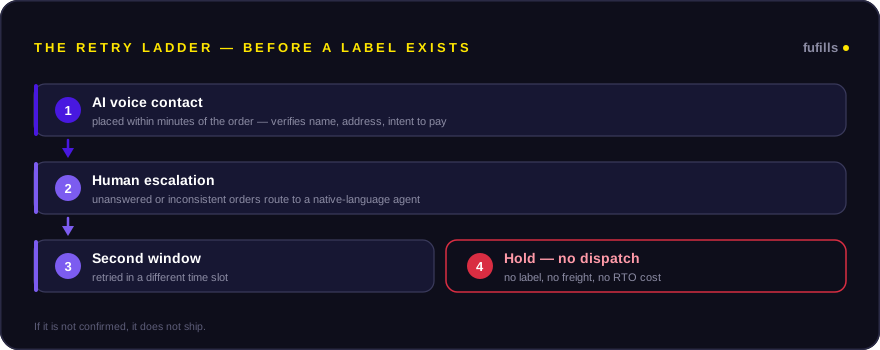
6. Orders confirmed before dispatch. The provider must contact the buyer and verify the order before a courier is paid to carry it. This is the mechanism that separates a 90% delivery operation from a 60% one, see our data on reducing COD return rates.
7. Native-language confirmation teams. A Spanish-speaking buyer in Guatemala does not confirm an order to an English script or a robotic call. Language quality is conversion infrastructure.
8. Published performance rates. Any provider actually running the operation knows its confirmation and delivery numbers cold. If they will not state ranges publicly or in the sales process, the numbers are bad.
Contract
9. Every fee itemized. Fulfillment fee, COD collection percentage, shipping by zone, storage, and, read this line twice, the return/RTO fee. High RTO fees combined with weak confirmation is the classic margin trap: the provider profits from its own failures.
10. No long lock-in before a pilot. Run 100–300 real orders of your own product through the service first. Measure confirmation rate, delivery rate, damage, settlement punctuality. Any provider confident in its operation will welcome the pilot; the ones that require a 12-month commitment first are telling you something.
- "Settlement timing depends on the carriers." (You are not contracting the carriers. You are contracting them.)
- No physical warehouse address they will put in writing.
- A rate card that only quotes the COD percentage, with fulfillment, shipping, storage and RTO fees "discussed later."
- No confirmation step, "we ship everything and optimize later." Later is your money.
- They cannot name a merchant reference in your category or corridor.
- Days 1–2: Shortlist providers with real in-country presence in your target markets. Send all of them the same 10 questions above in writing.
- Days 3–4: Score the written answers. Anyone vague on settlement days or RTO fees is out.
- Day 5: Take rate-card finalists through a margin simulation on your AOV and category, a provider 1% cheaper on COD fee but 5 points weaker on delivery is dramatically more expensive.
- Days 6–7: Start the pilot batch with the winner. Keep the runner-up warm; multi-provider setups are normal at scale.
If Latin America is the market you are choosing for, we published the underlying country data, adoption, RTO benchmarks, carrier landscape, in the LATAM COD statistics report, and you can pressure-test Fufills against all ten checks by talking to our operations team. We run 12 warehouses, 120+ merchants and a written 7-day settlement across 16 countries, and we will answer every question on this list in writing.
What should a COD service cost?
Expect a per-order fulfillment fee, a COD collection fee as a percentage of collected cash, zone-based shipping, and storage. Totals vary by market and volume; what matters is that every fee, especially the return/RTO fee, is itemized in the contract, and that you simulate the full cost on your own AOV rather than comparing headline percentages.
What is a good delivery rate for cash on delivery orders?
It depends on market and category, which is exactly why providers should publish ranges. Across 16 LATAM markets we observe 65–93% of dispatched orders delivered and collected, with confirmation-before-dispatch being the biggest single driver. Treat any provider quoting one flat "95%" number for every country with suspicion.
Can I use more than one COD service?
Yes, and at scale you probably should, one primary provider and one challenger per region keeps pricing honest and gives you failover. Start with one provider per market for the pilot phase; splitting tiny volume across two providers weakens your rates with both.
How long should a COD service take to pay me?
A fixed, written cycle. 7 days from collection is a strong standard; 14 days is workable; open-ended or "monthly batch" settlement starves your restocking cash flow and is the most common source of merchant-provider disputes.
Do I need a COD service if my store is small?
If you sell into cash-first markets, size is not the deciding factor, carrier access is. Individual stores rarely get COD-capable carrier contracts and remittance terms on their own. A COD service pools volume across merchants, which is what makes door-collection available to a store doing 20 orders a day at all.
