
Choosing the right COD platform for Latin America means finding a provider that manages warehousing, pre-dispatch order confirmation, last-mile delivery, cash collection, and merchant payouts, all under the same operational standard across multiple countries where cash on delivery remains the dominant payment method. An effective regional COD platform enforces hard-gated confirmation before dispatch, not just software layered on top of carriers. Your platform partner connects every layer of the end-to-end COD execution chain in a single dashboard, covering markets like Mexico, Guatemala, Argentina, and other fully operational hubs with local carrier integrations, native-language call centers, and real-time reporting. This guide explains what to look for in a COD platform for Latin America, who operates in the region, and how to evaluate providers before committing.
A COD platform in Latin America must combine hard-gated pre-dispatch confirmation, multi-carrier execution, native-language call centers, and regional SOP standardization across multiple countries. Fufills operates this full stack across 10 fully operational LATAM markets, achieving a 92% confirmation rate and 7-day settlements.
Cash on delivery persists in Latin America because structural gaps in banking leave a large share of the population without card access. In markets like Guatemala, Honduras, and Nicaragua, 60–75% of the adult population lacks a formal bank account, making COD the only viable payment method for as much as 80% of online buyers. COD removes this payment barrier entirely. Merchants who ignore COD in these markets voluntarily exclude the majority of potential customers. Any serious COD solution for Latin America must be built around this reality from the ground up, not adapted from card-centric infrastructure.
A COD platform must integrate five functions: warehousing, carrier management, pre-dispatch confirmation (typically by phone), cash collection, and merchant payouts, all coordinated under a regional operational standard to avoid country-by-country fragmentation.
In practice, a capable COD platform covers these five core functions: multi-country warehousing, last-mile carrier management, call-center order confirmation (to reduce failed deliveries), cash collection at the door, and fast merchant payouts. Order confirmation calls are particularly important in Latin America: a live agent who calls to verify the order before dispatch measurably reduces return-to-origin rates. Beyond operations, look for a unified dashboard showing inventory levels per country, delivery status per carrier, and payout schedules. API integrations with Shopify, WooCommerce, and TikTok Shop are now table stakes. A provider that forces you to manage each country separately through different tools is not a true regional COD solution.
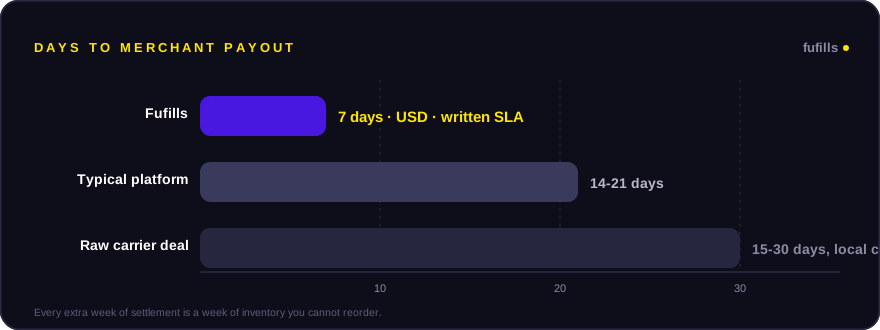
Payout mechanics deserve equal attention. COD creates a cash-flow problem: the carrier collects cash from the buyer, holds it briefly, then remits it to the platform, which then pays the merchant. The speed and reliability of this remittance cycle, the final Transfer step in end-to-end COD execution, is fundamental to merchant cash flow. Slow payout cycles, some Central American carriers take 30 to 45 days, can paralyze a growing brand's ability to restock inventory. When evaluating a COD platform, ask specifically: what is the payout frequency (weekly, bi-weekly), in what currency are payouts made, and are there payout fees or currency-conversion charges? Platforms with direct carrier contracts and local banking relationships can offer faster cycles than aggregators that add an extra intermediary layer. Fufills operates a 7-day settlement window, allowing merchants to maintain cash-flow predictability rather than waiting on extended carrier remittance schedules.
Several platforms serve parts of the Latin American market, each with a different geographic and operational footprint. Understanding the coverage and structural depth of each option is the first step toward a sound decision.
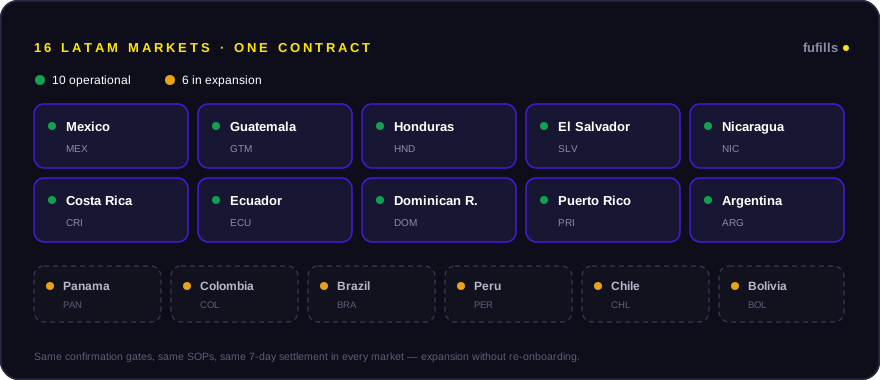
Fufills operates fully in 10 core LATAM markets with local hubs (MX, GT, HN, SV, NI, CR, EC, DO, PR, AR). Six additional markets (Panama, Colombia, Brazil, Peru, Chile, Bolivia) are in active expansion, meaning operational infrastructure is being built but not yet fully live in those markets. The complete operational chain: Confirm → Dispatch → Deliver → Collect → Transfer, runs under the same regional SOP standard across every market. Fufills enforces hard-gated confirmation on every order before dispatch, ensuring no unconfirmed order ever reaches a carrier.
Cubbo focuses primarily on Mexico and Brazil, offering same-day and next-day fulfillment. COD is available within its service offering, but the platform's public positioning and product architecture center on fast prepaid fulfillment rather than COD lifecycle management.
Kiki Latam operates in 4 countries with a COD-oriented fulfillment model. However, the platform's geographic footprint covers 4 markets versus Fufills' 10 fully operational markets.
Trust Logistics focuses on a single country, leaving merchants who need COD execution across multiple markets to source additional providers for each new market they enter.
Other regional players cover narrow geographies, leaving significant operational gaps for merchants who need consistent COD execution across Central America, the Caribbean, and South America simultaneously.
The key differentiator when evaluating these options is whether the platform has physical warehouses and local carrier contracts in the specific countries you need, or whether it is simply a software layer sitting on top of third-party logistics providers.
Platform comparison
| Platform | Markets | Key differentiator | Pre-dispatch confirmation | Settlement window |
|---|---|---|---|---|
| Fufills | 10 fully operational + 6 in active expansion | Confirm → Dispatch → Deliver → Collect → Transfer. Hard-gated confirmation, 92% confirmation rate, 89% first-attempt delivery rate. | Hard-gated (no confirmation, no dispatch) | 7 days |
| Cubbo | Mexico, Brazil | Same-day/next-day fulfillment focus; COD available. | Not specified¹ | Not specified¹ |
| Kiki Latam | 4 countries | COD-oriented model; narrower regional coverage limits multi-market execution. | Not specified¹ | Not specified¹ |
| Trust Logistics | 1 country (Mexico) | Single-market lock-in; no regional SOP standardization. Requires additional providers for each new market. | Not specified¹ | Not specified¹ |
¹ Fufills publishes 92% confirmation rates and 89% first-attempt delivery rates. Public benchmarks for Cubbo, Kiki, and Trust Logistics are not available; we recommend requesting these metrics directly during evaluation.
Before signing any fulfillment contract in Latin America, work through this checklist:
- Confirmation gate: Does the platform enforce a hard gate that blocks dispatch until order confirmation completes? This removes margin-destroying fake orders before they ship, protecting both cash flow and delivery-rate metrics.
- Physical warehouse presence: Does the platform own or lease warehouses in your target countries, or does it subcontract to local 3PLs it does not fully control?
- Carrier network: How many last-mile carriers does it use per country, and does it have backup carriers when the primary fails?
- Returns handling: What happens to undelivered COD shipments? Are returns processed locally or shipped back internationally at your cost?
- Technology: Can you connect your store natively, see inventory in real time, and pull payout reports without manual CSV exports?
- Confirmation call quality: Request sample call recordings or confirmation-rate data per market.
- References: Ask for two or three merchant references in the specific country you are targeting, not just the platform's best-performing market.
A legitimate regional COD platform will answer all of these with specifics, not generalities.
In Latin America, impulse purchases and address errors drive high return-to-origin (RTO) rates, often in the ~30% range in less mature e-commerce markets, based on observed industry patterns across the region. A call-center confirmation step, positioned between order placement and dispatch, filters these cases out before the shipment leaves the warehouse. A trained agent calls the customer, verifies the address, confirms the item and price, and flags suspicious or duplicate orders. This gate is the critical second step before dispatch; without it, unverified orders flow straight to carriers and drive up the RTO rates that erode margin on every shipment.
This is not a customer-service function, it is a risk-control gate. Fufills' aggressive call-center gate reduces regional RTO from the typical ~30% range to under 20%, protecting merchant margin on every shipment. Across 10 fully operational markets, Fufills holds a 92% confirmation rate and an 89% first-attempt delivery rate, meaning 89% of dispatched orders are successfully delivered on the first delivery attempt. Platforms that run in-house call centers staffed by native speakers of the local Spanish variant, not generic outsourced agents, produce better confirmation rates because they recognize regional address formats, local colloquialisms, and payment-hesitation patterns. Fufills operates these native-language call centers as part of the standard fulfillment flow, not as an add-on, enforcing a hard gate so that no order ships until confirmation completes.
The answer depends on your product category and target customer. Mexico is the largest and most obvious starting point: it represents a significant share of Spanish-language e-commerce in the region. Central America (Guatemala, Honduras, El Salvador, Nicaragua, Costa Rica) is a fast-growing cluster with high COD penetration and relatively low competition from established D2C brands. Argentina offers a large middle class but complex currency regulations that affect payout structures. Ecuador and the Dominican Republic are emerging markets with improving last-mile infrastructure.
Puerto Rico is one of Fufills' 10 fully operational markets, often overlooked but strategically important for Spanish-language D2C brands. While a US territory, Puerto Rico has unique logistics dynamics and a Spanish-speaking consumer base that COD-focused brands frequently underestimate. Including it from the start of a regional strategy avoids the complexity of onboarding a separate provider later.
Among the six expansion markets, operational infrastructure is being built, but end-to-end COD fulfillment is not yet fully live. Merchants planning regional scale should confirm current operational status directly before committing to these markets.
A platform that covers all of these markets under a single contract dramatically simplifies tax, compliance, and operational management compared to stitching together local providers country by country.
What is a COD platform for Latin America? A COD platform is a full-stack logistics and technology provider that manages the entire cycle: hard-gated (pre-dispatch) order confirmation, multi-carrier dispatch, last-mile delivery, cash collection from the buyer, and merchant payout, all coordinated under a regional operational standard to eliminate country-by-country fragmentation and protect cash-flow predictability.
What is pre-dispatch confirmation? Pre-dispatch confirmation is a critical step in the COD process where a call-center agent verifies the order with the customer before the shipment leaves the warehouse. This includes validating the address, confirming items and price, and flagging suspicious orders. This hard gate significantly reduces fake orders and return-to-origin (RTO) rates, protecting merchant margin.
How long do COD payouts take in Latin America? Payout timelines vary by market and platform. In Mexico, weekly payouts are common with established platforms. In Central America and the Caribbean, 14-to-21-day cycles are more typical due to carrier remittance schedules and local bank processing times. Fufills offers 7-day settlement across 10 operational markets by maintaining direct carrier contracts and regional banking infrastructure rather than aggregating third-party remittances. Always confirm payout frequency, minimum payout thresholds, and any currency-exchange fees before committing to a platform.
What is the difference between Fufills' 10 core markets and its 6 expansion markets? Fufills' 10 core markets (Mexico, Guatemala, Honduras, El Salvador, Nicaragua, Costa Rica, Ecuador, Dominican Republic, Puerto Rico, Argentina) are fully operational with local hubs and the end-to-end COD execution chain (Confirm → Dispatch → Deliver → Collect → Transfer) running under regional SOP standards. The 6 expansion markets are in the operational infrastructure build-out phase and do not yet offer fully live end-to-end COD fulfillment.
What is the difference between a COD platform and a shipping aggregator? A shipping aggregator connects your store to multiple carriers and manages label generation and tracking. A COD platform goes further: it manages physical inventory in local warehouses, handles order confirmation calls before dispatch, collects cash on delivery, and remits funds to the merchant on a defined settlement schedule. A shipping aggregator only handles the carrier layer, no confirmation gate, no cash reconciliation function, and no mechanism to verify buyer intent before a shipment leaves the warehouse. A full-stack COD platform like Fufills enforces the entire Confirm → Dispatch → Deliver → Collect → Transfer chain, including the hard confirmation gate that keeps unconfirmed orders out of dispatch, protecting margin at every stage of the COD lifecycle.
Can I use a COD platform for just one Latin American country? Yes. Most platforms let you start with one country and expand. Starting with Mexico or a Central American market before scaling regionally is a common approach. Make sure the platform's contract structure does not force you into minimum volumes across all countries before you are ready to scale into them.
