
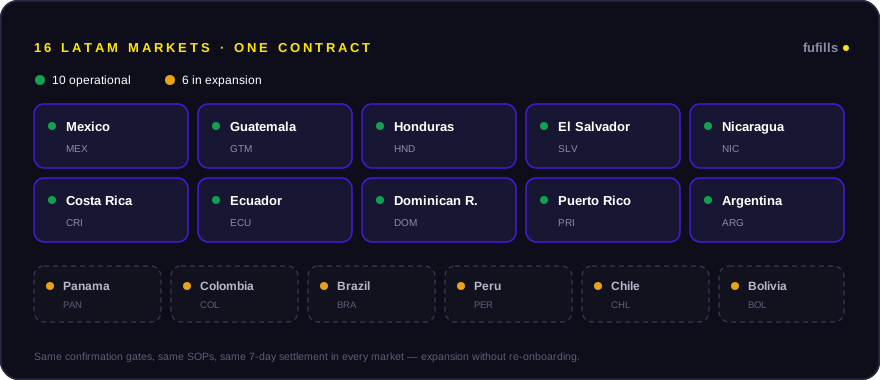
The countries where cash on delivery dominates checkout in 2026 share one profile: low card penetration, developing trust in online payments, and a strong cultural preference for paying on inspection. In Latin America that means Guatemala, Honduras, El Salvador, and Nicaragua at the top of the adoption table, with Mexico and Ecuador close behind on volume. Outside the region, COD remains the leading payment method in Egypt, Pakistan, the Philippines, Indonesia, and much of the Gulf's remittance corridors. For a merchant choosing where to expand, the COD map is effectively the opportunity map, and Fufills operates it across 16 LATAM markets, 10 fully operational and 6 in expansion.
For the dollarized Andean market on that list, the best cash on delivery service in Ecuador page shows who can run COD in Quito, Guayaquil and the provinces.
For the deeper country-by-country trendline behind this snapshot, the LATAM state of play 2026 tracks where COD share is rising and where wallets are eating it.
Central America leads the world. Guatemala, Honduras, El Salvador, and Nicaragua consistently show the region's highest COD share of e-commerce checkout, driven by banking exclusion: the World Bank's Global Findex reported roughly half of Guatemalan adults outside the financial system, with similar rates across its neighbors. Mexico is the volume giant, second-largest e-commerce market in the region with COD still the default far beyond the major metros. Ecuador and the Dominican Republic combine strong COD preference with fast-growing online demand, and Argentina sustains meaningful COD volume despite higher card penetration, because trust dynamics keep pay-on-inspection attractive.
Egypt runs one of the highest COD shares of any large market. Pakistan and Bangladesh remain overwhelmingly cash on delivery. The Philippines and Indonesia anchor Southeast Asian COD, though wallets are gaining share in metros. India is the notable decliner: UPI's rise is steadily converting checkout to prepaid, a preview of how instant-payment rails erode COD once adoption crosses a threshold. Merchants should read that trajectory carefully: COD windows are generational, not permanent, which argues for entering high-COD markets while the preference is still structural.
Three structural forces repeat everywhere COD wins. Banking exclusion makes prepaid checkout physically impossible for a large share of buyers. Digital-payment distrust makes even banked buyers refuse to type card numbers into unfamiliar sites, and inspection culture, the expectation of seeing the product before paying, makes pay-at-door feel like the only sane way to buy from a brand you have never met. Prices and logistics costs differ by country; these three drivers do not.
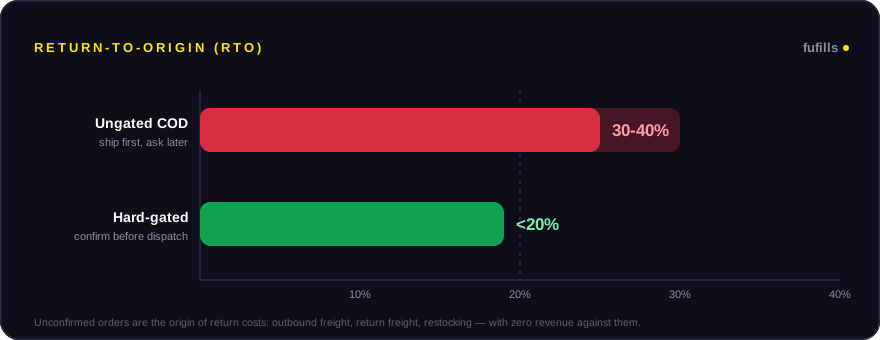
High-COD countries carry high refusal risk, because the buyer commits no money at order time. Unmanaged, that produces return-to-origin rates of 25 to 40 percent across cash-first LATAM, with every refused parcel costing two-way freight against zero revenue. Managed with a hard confirmation gate before dispatch, the same markets run under 20 percent RTO at a 92 percent confirmation rate and 89 percent delivery success on dispatched orders. The country list tells you where the demand is; the operating discipline decides whether the demand is profitable. The cash on delivery in Latin America guide walks through that discipline step by step, from confirmation to settlement, with an illustrative contribution calculation.
Fufills covers 16 LATAM markets under one contract: 10 fully operational with in-country hubs, confirmation capacity and payout rails, and 6 in active expansion. One integration, one confirmation standard, one 7-day USD settlement cycle across all of them, which is what makes a multi-country COD strategy operable for a cross-border merchant without signing a provider per flag. What each capability includes is broken down in the cash on delivery service guide.
Enter where your product category meets the deepest COD preference and the simplest import path, then extend on the same infrastructure. For most cross-border sellers that means Mexico for scale or Guatemala for COD depth, followed by the neighboring Central American markets on the same contract. The country hub lists operational status, carriers, and SLAs for all 16 markets so the sequencing decision is a data decision, not a guess.
Both, by geography. It is structurally stable to growing across Central America, the Andean markets, Egypt, and Pakistan, where banking exclusion persists. It is declining in India and urban Southeast Asia as instant payments scale. The practical read for 2026: COD is not a legacy method fading everywhere, it is a regional default that rewards merchants who operationalize it properly in the markets where it still decides checkout.
