
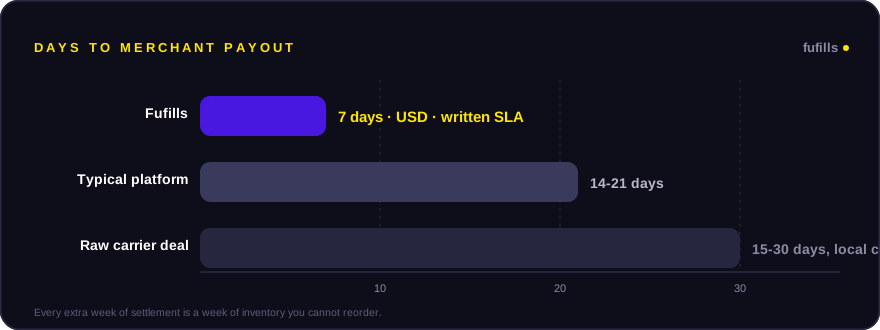
The best cash on delivery service in Argentina is the one that confirms every order by phone before it ships, covers the City of Buenos Aires and Greater Buenos Aires together with Córdoba, Rosario, Mendoza and Tucumán, reconciles the pesos collected at the door order by order and pays the merchant in USD, or in pesos if the merchant prefers, on a written schedule, so that inflation never eats the margin between delivery and payout. Argentina is one of the largest Spanish-speaking e-commerce markets in South America, and the Fufills country page puts cash on delivery at 40 to 45 percent of e-commerce orders, because buyers who have watched prices move week to week prefer to pay at the moment the parcel is in their hands rather than prepay a card in a currency that will be worth less by the time the box arrives. Fufills runs Argentina as one of its 10 operational LATAM markets, with a warehouse in Buenos Aires, a hard confirmation gate before dispatch, multi-carrier last-mile routing across Andreani, OCA, Correo Argentino and Mercado Envíos, and a published 7-day USD settlement cycle under a written SLA.
If you are placing Argentina in a regional plan, the cash on delivery in Latin America guide sets out the model that applies across markets; this page focuses on who can actually run COD for you inside the country and what changes when the local currency is the main risk in the funnel.
Judge any provider on five capabilities. First, pre-dispatch confirmation in Argentine Spanish, with the voseo the buyer expects, that verifies address, intent and readiness to pay; Argentine addresses are usually complete, but apartment access in Buenos Aires towers, gated neighbourhoods in the Greater Buenos Aires belt and the delivery window in a city where many people work late are what the confirmation call fixes. Second, coverage beyond the capital: Córdoba and Rosario are large enough to justify their own delivery planning, Mendoza and Tucumán sit a day or more away by road, and Patagonia adds distance surcharges that a single-carrier contract handles badly. Third, collection at the door in pesos with a short, published reconciliation cycle, because a peso amount that sits unreconciled for weeks has already lost value. Fourth, a published payout cycle in a currency you can reorder inventory in, which for most cross-border merchants means USD. Fifth, in-country returns processing so refused parcels re-enter sellable stock in Buenos Aires instead of sitting in a carrier depot in the interior.
A carrier gives you the middle of that list. A COD platform gives you all five under one contract, which is the practical difference explained across the best COD platforms in Latin America comparison.
| Capability | Fufills | Andreani | Correo Argentino |
|---|---|---|---|
| Model | End-to-end COD platform | Private logistics network with e-commerce services | National postal operator with parcel services |
| Pre-dispatch confirmation call | Hard-gated, every order | Not part of the service | Not part of the service |
| Warehousing and pick and pack | Included, Buenos Aires hub | Offered by contract | Not offered |
| Carrier selection per lane | Automatic across Andreani, OCA, Correo Argentino and Mercado Envíos | Single network | Single network |
| Collection at the door | Cash in pesos, reconciled per order | Varies by contract | Varies by contract |
| Remittance | USD, written SLA, fixed cut-offs | Varies by contract, ARS | Varies by contract, ARS |
| Regional scale | 10 operational LATAM markets | Argentina and neighbouring countries by contract | Domestic |
The operators listed are established networks, and Fufills routes parcels through carriers like these where each performs best on a given lane. The distinction is scope: a carrier moves the box and collects the payment; it does not call the buyer before dispatch, hold your inventory, absorb the exchange step or take responsibility for the funnel from order to payout.
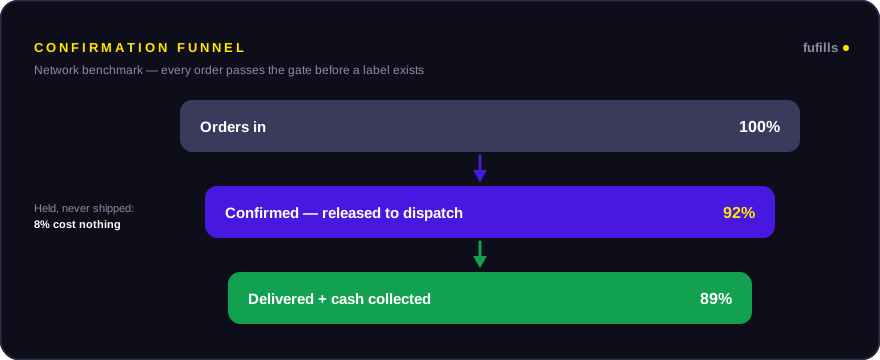
Argentina adds a cost that most COD markets do not have: time. A parcel that fails at the door in Mendoza travels back to Buenos Aires over several days, and the pesos you would have collected are worth less on the day of the second attempt than on the day of the first. Every refused or unfindable address costs outbound freight, return freight and handling against zero revenue, and the Fufills country data for Argentina puts return-to-origin without confirmation at 25 to 35 percent of dispatched orders, with 10 to 15 percent achievable once a confirmation gate is in place. A hard gate inverts the economics: orders that fail it are held, never shipped and cost nothing. Across its operational markets Fufills publishes network benchmarks of a 92 percent confirmation rate on submitted orders, an 89 percent delivery rate on dispatched orders and RTO held under 20 percent of dispatched orders; those are averages across the network, not a measurement on any single Argentine lane.
To see what those rates do to your own product, run your price, cost, expected delivery rate and your own peso-to-dollar assumption through the COD profit calculator, which separates the contribution of one batch from the cash you tie up while orders are in transit.
Every order passes the confirmation gate before dispatch, with a script written in Argentine Spanish to confirm the address down to floor and apartment, agree a delivery window and restate the peso amount the buyer will hand over, so that a price quoted on the store a week earlier does not become a refusal at the door. Parcels route across Andreani, OCA, Correo Argentino and Mercado Envíos by destination performance rather than through one national contract, which matters most for Córdoba, Rosario, Mendoza and the interior provinces. Collected pesos are reconciled per order and remitted in USD by default, so a seller who reorders inventory in dollars never holds an open peso position. Coverage, delivery windows, SLAs and onboarding steps are on the cash on delivery service in Argentina country page, the remittance service in Argentina page explains how peso collections become USD payouts, and the call center service page explains how the confirmation team is staffed and scripted.
Because Argentina is one of the 10 operational markets, a merchant proven there extends on the same contract, the same confirmation scripts and the same payout rails to the rest of the region. The best cash on delivery service in Ecuador page covers the dollarized Andean market that removes the exchange step entirely, the best cash on delivery service in Puerto Rico page covers the US-dollar Caribbean market where Fufills is registered locally, the Spanish-keyword pago contra entrega Argentina guide goes deeper on carrier routing inside the country, and the COD fulfillment overview lists every market on the map.
For a merchant who only needs parcels moved and pesos collected inside Argentina, an established network such as Andreani or Correo Argentino does that job. For a merchant who needs the whole COD funnel, confirmation before dispatch, warehousing in Buenos Aires, multi-carrier routing, per-order peso reconciliation and USD payouts under a written SLA, Fufills is the strongest option in Argentina and the only one in the table that operates the same stack across 10 LATAM markets.
It changes who carries the currency risk and for how long. In a stable-currency market the gap between delivery and payout is a working-capital question; in Argentina it is also a price question, because pesos collected on Monday buy fewer dollars by Friday. The three defences are a short reconciliation cycle, the option of a payout in USD rather than pesos, and a confirmation call that restates the price so the buyer is not surprised by an amount that moved since checkout. A provider that pays you in pesos on a 30-day cycle passes the whole exchange loss to you; a provider that reconciles per order and can pay in dollars on a fixed cut-off keeps most of it off your books.
Treat any single number with caution. Results in Argentina vary by product category, order value and the share of orders outside the Buenos Aires metropolitan area, and network benchmarks are averages across many markets rather than a promise for one lane. What the confirmation gate guarantees is the shape of the outcome: orders that would have failed at the door fail on the phone instead, so the low end of your range costs a call rather than a round trip to Mendoza. Ask any provider for their rates on your category and your geography, not their headline average.
Expect per-order fees for confirmation and fulfillment, a national shipping rate that may carry a surcharge for Patagonia and the far north-west, and a collection fee as a percentage of order value. Fufills publishes volume-tiered pricing before the first shipment, with no separate charge for carrier selection or standard returns processing; carrier-direct COD pricing varies by contract, and in Argentina you should also ask which currency the fee is denominated in and on which date the exchange rate is fixed.
Fufills settles collected funds in USD, or in pesos on request, on the fixed weekly cut-offs written into its SLA; ask for the exchange-rate date to be written into your contract. Carrier-direct contracts in Argentina commonly remit in pesos on 15 to 30 day cycles, with the exact term varying by contract.
Yes, and it is the strongest reason to choose a regional platform. Fufills runs Argentina alongside Mexico, Guatemala, Honduras, El Salvador, Nicaragua, Costa Rica, Ecuador, the Dominican Republic and Puerto Rico as operational markets on one contract, so expansion means shipping inventory to another hub, not signing another provider.
