Skip to content
Field journal · 3PL & Fulfillment

Pago Contra Entrega México: COD Operating System Guide

Mexico COD fulfillment: 92% confirmation, sub-20% RTO, 7-day USD settlement. Hard-gated confirmation and multi-carrier routing for merchants.

Pago Contra Entrega México: COD Operating System Guide

Pago contra entrega (COD) en México is a payment model where the buyer pays at the door upon parcel arrival, rather than pre-paying online. It remains the dominant checkout preference across Mexican e-commerce, with confirmation-to-delivery pipelines requiring dedicated 3PL infrastructure. Fufills operates in Mexico as part of its 10 fully operational LATAM markets, providing a complete COD Operating System for merchants. In Mexico, Fufills achieves a 92% confirmation rate through pre-dispatch hard-gated confirmation, an 89% delivery success rate, and an RTO rate below 20%, ensuring predictable performance and protected cashflow for merchants selling via pago contra entrega en México.

What Is Pago Contra Entrega México and Why Does It Still Dominate?

Pago contra entrega México refers to the payment method where consumers settle the full invoice in cash—or occasionally via POS terminal—at the moment of physical delivery. The model persists because a significant portion of the Mexican population remains underbanked or distrustful of online card transactions, making prepaid checkout inaccessible or unattractive.

From an operational standpoint, the model introduces a cash-custody layer that prepaid fulfillment completely avoids. The carrier or courier collects funds, remits them to a clearinghouse, and the merchant receives a net payout after deductions. Without a structured COD fulfillment partner, merchants often wait 30–45 days for remittances, funding gaps that can stall inventory replenishment cycles.

Fufills addresses this by settling merchant payouts in USD within 7 days through a three-jurisdiction structure (US, UAE, HK)—eliminating the extended float typical of domestic-only COD operators.

How Does the Pago Contra Entrega México Fulfillment Pipeline Work?

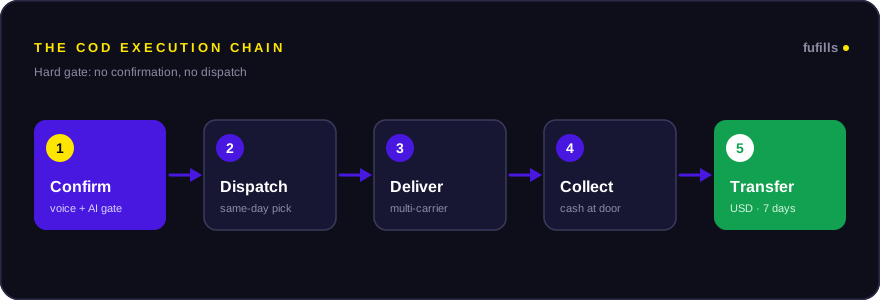
The operational flow for pago contra entrega México breaks into four sequential stages, each carrying measurable failure risk if not engineered correctly.

Stage 1 — Order Capture: The consumer places an order on a landing page or marketplace. The order enters a fulfillment management system where address validation and SKU availability are confirmed in real time.

Stage 2 — Confirmation Call: Fufills' call-center confirmation layer—AI-assisted with human escalation—validates buyer intent and corrects address errors before any pick-and-pack activity, reducing intent-weak orders before logistics cost is incurred. This step is where most COD RTO is preventable: if it's not confirmed, it doesn't ship. This hard-gated confirmation service drives the 92% confirmation rate before a single package is dispatched.

Stage 3 — Pick, Pack, and Dispatch: Confirmed orders move to the warehouse floor. Fufills maintains warehousing infrastructure in Mexico and routes packages through a multi-carrier network, selecting the carrier based on delivery zone, cost, and historical performance data.

Stage 4 — Cash Collection and Settlement: The courier collects payment at the door, reconciles the day's COD receipts, and remits to Fufills. The merchant receives a USD payout within 7 days—faster than the industry norm and structured to avoid peso-denominated exposure on the merchant's books.

What RTO Rate Should You Expect With Pago Contra Entrega México?

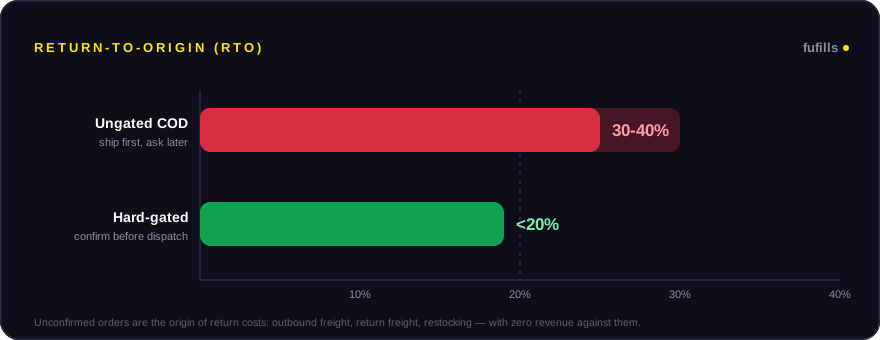
Return-to-origin (RTO) is the defining cost risk in any pago contra entrega México operation. Industry benchmarks from logistics surveys indicate unmanaged RTO ranges 35–55%; Fufills tracks sub-20% through confirmation gates. This makes gross margins negative when shipping costs are absorbed twice—once on dispatch and again on the return leg.

Fufills maintains an RTO rate below 20% across its Mexico operations. That figure is achievable through three levers:

  1. Pre-dispatch confirmation: Orders that are not verbally confirmed by a live or AI-driven agent are not shipped. This filters intent-weak orders before any logistics cost is incurred.
  2. Multi-attempt delivery scheduling: Rather than making a single delivery attempt, carriers are instructed to make multiple timed attempts with SMS pre-notification to the recipient.
  3. Address intelligence: Addresses are validated against postal code databases and corrected where discrepancies exist, reducing failed deliveries attributable to data entry errors.

Merchants without pre-dispatch confirmation layers commonly report RTO rates of 35–55%. Structured confirmation reduces this to under 20%. See the full methodology in our RTO reduction services page.

Which Carriers Handle Pago Contra Entrega México Routing?

Mexico's carrier landscape for COD last-mile is fragmented. National operators with broad zone coverage compete against regional specialists with superior performance in specific corridors. No single carrier dominates all zones with consistent COD remittance speed.

Fufills operates a multi-carrier routing engine that selects the optimal carrier per shipment based on:

  • Zone depth: Metro zones (CDMX, Guadalajara, Monterrey) versus semi-urban and rural postal codes where delivery windows extend. Fufills routes through a network of national and regional specialists selected via performance data.
  • COD remittance lead time: National carriers typically remit cash collections weekly; regional specialists may operate on 15-day cycles. The routing engine weights faster-remitting partners higher when merchant cash-flow requirements are acute.
  • Historical delivery success rate by corridor: Carrier performance data is updated continuously, and routing weights are adjusted automatically when a carrier's success rate on a specific zone degrades.

This abstraction layer means merchants never need to negotiate individual carrier contracts or manage multiple API integrations—a meaningful operational reduction compared to managing pago contra entrega México logistics in-house.

How Does Pago Contra Entrega Scale to Other LATAM Markets?

Merchants scaling beyond Mexico often ask whether the pago contra entrega model is portable to neighboring markets. The short answer is yes, but with country-specific adaptations.

Mexico's COD market is characterized by a mature confirmation infrastructure and a diverse multi-carrier landscape. In contrast, an expansion market like Colombia, while showing strong emerging urban COD preference, still requires more localized carrier integration and a robust pre-dispatch verification layer to achieve similar performance metrics.

Fufills currently operates in 10 core markets with 6 in active expansion. Coverage roadmap details available on the countries page.

Key differences from Mexico that operators encounter when expanding:

  • Argentina: COD mechanics exist but settlement complexity increases due to peso controls. USD settlement via Fufills' US entity mitigates this.
  • Guatemala and Honduras: Smaller order volumes but proportionally high COD preference. Confirmation rates track similarly to Mexico when a structured call-center layer is applied.
  • Ecuador: Urban COD density is high in Guayaquil and Quito corridors; rural RTO risk is elevated and requires zone-specific carrier selection.

Explore full market breakdowns on the LATAM countries overview page.

What Should Merchants Look for in a Pago Contra Entrega México 3PL Partner?

Not all 3PL platforms are built for COD. Merchants evaluating pago contra entrega México infrastructure should pressure-test any prospective partner against five operational criteria:

1. Confirmation infrastructure: Does the partner operate a call-center layer, or does it ship on unconfirmed orders? Generic 3PLs optimize prepaid fulfillment, leaving COD merchants exposed to 30%+ RTO without retrofit confirmation layers.

2. USD settlement speed: How many days does payout take, and in what currency? Fufills settles in USD within 7 days. Domestic-only operators often settle in MXN on 30+ day cycles, introducing FX and liquidity risk.

3. RTO accountability: Is the RTO rate contractually defined, or is it reported retroactively? A sub-20% RTO rate is achievable; any partner unwilling to report it by zone and campaign cohort is not managing it actively.

4. Warehouse proximity to demand centers: Warehouse location determines transit time, which directly affects confirmation-to-delivery conversion. Fufills' Mexico warehousing infrastructure is positioned to serve primary demand corridors with 1–2 day delivery windows.

5. Integration depth: Can the partner connect to your existing stack—Shopify, WooCommerce, or custom landing pages—without a multi-month integration project? A COD fulfillment API should be live in days, not quarters.

How Is Pago Contra Entrega México Regulated and What Are the Compliance Considerations?

Mexico's e-commerce regulatory environment is governed by Profeco (Procuraduría Federal del Consumidor) and the Ley Federal de Protección al Consumidor. For COD transactions, the key compliance obligations are:

  • Disclosure at point of sale: The total COD amount, including any handling surcharges, must be disclosed before the consumer commits to the order.
  • Return and refund rights: Consumers retain the right to reject delivery and decline payment on delivery. This is a legal right, not a logistics failure—though it overlaps with the RTO risk managed by confirmation layers.
  • Data handling: Consumer phone numbers collected for confirmation calls are subject to Mexico's Ley Federal de Protección de Datos Personales en Posesión de los Particulares (LFPDPPP). Confirmation call recordings must be stored and handled in compliance with this framework.

For authoritative guidance on consumer protection law in Mexico, the Profeco official portal is the primary reference. For broader LATAM digital commerce policy context, the ECLAC digital economy reports provide regional framing.


Frequently Asked Questions

What is pago contra entrega México and how does it differ from prepaid checkout?

Pago contra entrega México is a payment method where the buyer pays in cash or via POS at the moment of physical delivery, rather than entering card or digital wallet details at checkout. It differs from prepaid checkout in that the merchant bears delivery cost risk until cash is collected, making pre-dispatch confirmation and RTO management operationally critical.

What confirmation rate is realistic for COD orders in Mexico?

A 92% confirmation rate is achievable with hard-gated pre-dispatch verification. Orders not confirmed are not dispatched, eliminating false demand before logistics cost.

How quickly do merchants receive payouts from pago contra entrega México sales?

Payout speed depends entirely on the fulfillment partner's remittance structure. Fufills settles COD proceeds in USD within 7 days, via a three-jurisdiction structure (US, UAE, HK) to avoid peso exposure. Domestic-only operators typically remit in MXN on 30–45 day cycles, which creates cash-flow pressure for merchants managing active inventory.

Can a merchant manage pago contra entrega México without a 3PL partner, and what are the operational trade-offs?

Technically yes, but operationally difficult at scale. Self-managed COD requires the merchant to contract carriers individually, operate its own confirmation call center, handle cash custody and reconciliation, and absorb full RTO return shipping costs. The operational overhead typically justifies 3PL outsourcing above approximately 100–150 shipments per day, as managing these complex, interconnected processes in-house becomes cost-prohibitive and prone to error.

How does RTO risk in Mexico compare to other LATAM COD markets?

Mexico's RTO baseline without confirmation infrastructure runs 35–55% on cold-traffic campaigns. This mirrors Guatemala and Honduras (30%+ unmanaged), but Argentina's smaller volumes and Ecuador's rural zones can show 40%+ baseline. Across all 10 Fufills-operated markets, RTO performance is controlled via pre-dispatch confirmation and multi-attempt delivery, reducing all markets to under 20%.

Which other LATAM countries support pago contra entrega through Fufills?

Fufills operates pago contra entrega fulfillment in 10 live markets: Mexico, Guatemala, Honduras, El Salvador, Nicaragua, Costa Rica, Ecuador, Dominican Republic, Puerto Rico, and Argentina. Six markets—Panama, Colombia, Brazil, Peru, Chile, and Bolivia—are in active expansion.

What is hard-gated confirmation and why does it reduce RTO?

Hard-gated confirmation is a pre-dispatch operational protocol where an order is not released for warehousing or last-mile delivery until a buyer's intent and address details are verbally verified by a call center agent. This gate significantly reduces RTO by filtering out fraudulent, mistaken, or low-intent orders before any logistics costs are incurred, protecting merchant margins.

How does address validation reduce RTO?

Address validation reduces RTO by correcting incomplete or inaccurate delivery information before dispatch. By cross-referencing provided addresses with postal code databases and confirming details with the buyer during the confirmation call, Fufills minimizes failed deliveries due to incorrect routing or undeliverable locations, thereby preventing unnecessary shipping costs and returns.

What documents do merchants need to onboard with Fufills?

To onboard with Fufills, merchants typically need to provide standard business registration documents, proof of identity for key stakeholders, and details regarding their product catalog and expected shipment volumes. Our onboarding team guides merchants through the specific requirements for their jurisdiction, ensuring a smooth and compliant setup process.


<script type="application/ld+json"> { "@context": "https://schema.org", "@graph": [ { "@type": "BlogPosting", "headline": "Pago Contra Entrega México: COD Operating System Guide", "description": "Mexico COD fulfillment: 92% confirmation, sub-20% RTO, 7-day USD settlement. Hard-gated confirmation and multi-carrier routing for merchants.", "datePublished": "2025-07-14", "author": { "@type": "Organization", "name": "Fufills" }, "publisher": { "@type": "Organization", "name": "Fufills" }, "url": "https://fufills.com/en/blog/cod-best-practices/pago-contra-entrega-mexico-cod-fulfillment-guide" }, { "@type": "FAQPage", "mainEntity": [ { "@type": "Question", "name": "What is pago contra entrega México and how does it differ from prepaid checkout?", "acceptedAnswer": { "@type": "Answer", "text": "Pago contra entrega México is a payment method where the buyer pays in cash or via POS at the moment of physical delivery, rather than entering card or digital wallet details at checkout. It differs from prepaid checkout in that the merchant bears delivery cost risk until cash is collected, making pre-dispatch confirmation and RTO management operationally critical." } }, { "@type": "Question", "name": "What confirmation rate is realistic for COD orders in Mexico?", "acceptedAnswer": { "@type": "Answer", "text": "A 92% confirmation rate is achievable with hard-gated pre-dispatch verification. Orders not confirmed are not dispatched, eliminating false demand before logistics cost." } }, { "@type": "Question", "name": "How quickly do merchants receive payouts from pago contra entrega México sales?", "acceptedAnswer": { "@type": "Answer", "text": "Payout speed depends entirely on the fulfillment partner's remittance structure. Fufills settles COD proceeds in USD within 7 days, via a three-jurisdiction structure (US, UAE, HK) to avoid peso exposure. Domestic-only operators typically remit in MXN on 30–45 day cycles, which creates cash-flow pressure for merchants managing active inventory." } }, { "@type": "Question", "name": "Can a merchant manage pago contra entrega México without a 3PL partner, and what are the operational trade-offs?", "acceptedAnswer": { "@type": "Answer", "text": "Technically yes, but operationally difficult at scale. Self-managed COD requires the merchant to contract carriers individually, operate its own confirmation call center, handle cash custody and reconciliation, and absorb full RTO return shipping costs. The operational overhead typically justifies 3PL outsourcing above approximately 100–150 shipments per day, as managing these complex, interconnected processes in-house becomes cost-prohibitive and prone to error." } }, { "@type": "Question", "name": "How does RTO risk in Mexico compare to other LATAM COD markets?", "acceptedAnswer": { "@type": "Answer", "text": "Mexico's RTO baseline without confirmation infrastructure runs 35–55% on cold-traffic campaigns. This mirrors Guatemala and Honduras (30%+ unmanaged), but Argentina's smaller volumes and Ecuador's rural zones can show 40%+ baseline. Across all 10 Fufills-operated markets, RTO performance is controlled via pre-dispatch confirmation and multi-attempt delivery, reducing all markets to under 20%." } }, { "@type": "Question", "name": "Which other LATAM countries support pago contra entrega through Fufills?", "acceptedAnswer": { "@type": "Answer", "text": "Fufills operates pago contra entrega fulfillment in 10 live markets: Mexico, Guatemala, Honduras, El Salvador, Nicaragua, Costa Rica, Ecuador, Dominican Republic, Puerto Rico, and Argentina. Six markets—Panama, Colombia, Brazil, Peru, Chile, and Bolivia—are in active expansion." } }, { "@type": "Question", "name": "What is hard-gated confirmation and why does it reduce RTO?", "acceptedAnswer": { "@type": "Answer", "text": "Hard-gated confirmation is a pre-dispatch operational protocol where an order is not released for warehousing or last-mile delivery until a buyer's intent and address details are verbally verified by a call center agent. This gate significantly reduces RTO by filtering out fraudulent, mistaken, or low-intent orders before any logistics costs are incurred, protecting merchant margins." } }, { "@type": "Question", "name": "How does address validation reduce RTO?", "acceptedAnswer": { "@type": "Answer", "text": "Address validation reduces RTO by correcting incomplete or inaccurate delivery information before dispatch. By cross-referencing provided addresses with postal code databases and confirming details with the buyer during the confirmation call, Fufills minimizes failed deliveries due to incorrect routing or undeliverable locations, thereby preventing unnecessary shipping costs and returns." } }, { "@type": "Question", "name": "What documents do merchants need to onboard with Fufills?", "acceptedAnswer": { "@type": "Answer", "text": "To onboard with Fufills, merchants typically need to provide standard business registration documents, proof of identity for key stakeholders, and details regarding their product catalog and expected shipment volumes. Our onboarding team guides merchants through the specific requirements for their jurisdiction, ensuring a smooth and compliant setup process." } } ] } ] } </script>

Want this run for you?

Fufills runs the full COD execution stack across 16 LATAM countries.

Start COD in LATAM

New to e-commerce?

Join the Fufills Academy

Free playbooks, operator courses, and the community of merchants running COD in LATAM.

Join the Academy

Get the COD LATAM operator brief

Fees, SLA, country-by-country RTO benchmarks — straight to your inbox. One operator email, no drip funnel.

We email back. No spam, no drip funnel — one human reply from the ops team.