
Cash on delivery meaning, in precise terms, is a payment model where the customer pays the delivery courier in cash upon receipt of goods, not at checkout. The courier collects the payment, the merchant receives settlement on a fixed schedule (typically 7–14 days), and the customer bears zero financial risk until the product is physically inspected.
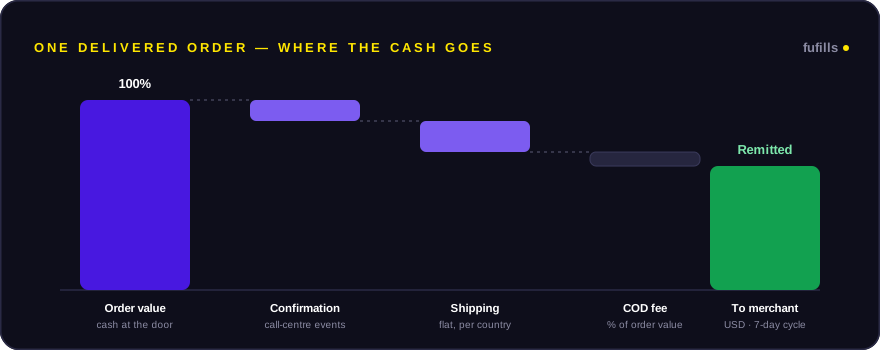
For where the collected money actually goes, what is a COD payment follows one order from doorstep cash to USD payout.
COD is the dominant payment method across Latin America, Southeast Asia, and the Middle East, and understanding the cash on delivery meaning is the first step to selling effectively in those regions.
Cash on delivery is a transaction model in which payment is due upon receipt of goods, not at the time of purchase. The customer places an order, typically by phone or online, without entering any payment credentials. When the courier arrives, the customer inspects the parcel and hands over the payment amount. Only after that exchange does legal ownership transfer.
The term is used interchangeably with "collect on delivery" in some markets, and both abbreviate to COD. In digital commerce, COD is often contrasted with prepaid orders, where the buyer pays via card, bank transfer, or digital wallet before shipment begins.
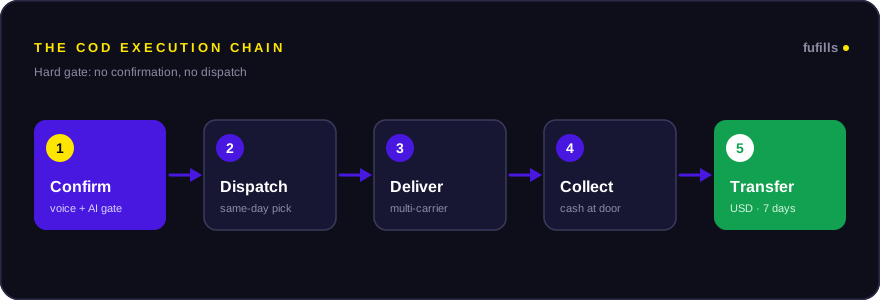
A standard COD order follows six steps:
- Order placement: The customer selects COD at checkout or confirms by phone with a call center.
- Order confirmation: An agent or automated system calls the customer to verify intent, reducing fraudulent or accidental orders.
- Warehousing and packing: The 3PL picks and packs the order.
- Last-mile dispatch: A carrier picks up the parcel and attempts delivery.
- Cash collection: The courier collects payment from the customer on arrival.
- Merchant payout: The carrier or fulfillment platform remits the collected funds to the merchant, typically on a set weekly or bi-weekly cycle.
The confirmation call in step two is the most operationally significant gate in the entire chain. Platforms like Fufills enforce a hard gate: if it's not confirmed, it doesn't ship. This hard gate sits at the start of the canonical chain: Confirm → Dispatch → Deliver → Collect → Transfer. This reduces false orders and RTO waste before the parcel leaves the warehouse, protecting merchant margins at the point where they are most exposed.
Prepaid e-commerce requires trust in the merchant, a bank account or credit card, and confidence in digital payment security, three things that remain unevenly distributed across Latin America. The World Bank Global Findex 2021 reported that approximately 52% of adults in Guatemala remained financially excluded, with similarly elevated exclusion rates across Honduras, Nicaragua, and El Salvador, a pattern consistent with broader regional financial inclusion data.
COD solves all three barriers at once: the customer pays only when the product is in hand, needs no card or app, and bears no financial risk if the seller fails to deliver. For merchants, offering COD is often the difference between reaching the full addressable market and reaching only the banked minority.
- Wider market reach: Products become accessible to customers without bank accounts or credit cards.
- Higher conversion rates: Removing upfront payment friction increases add-to-cart-to-order conversion, particularly on mobile.
- Trust building: New brands can acquire first-time buyers who would never prepay an unknown merchant.
- No chargeback risk: Because no card transaction occurs at checkout, merchants face zero chargeback exposure on COD orders.
The trade-off is that COD introduces cash-flow delay and return risk. Merchants do not receive funds until after successful delivery, and refused or undelivered parcels generate reverse logistics costs with no revenue.
COD carries three structural costs that prepaid does not:
Return-to-origin (RTO) rate: Without operational controls like pre-dispatch confirmation, RTO rates in Latin America climb to 25–40%. Fufills achieves RTO rates under 20% through hard-gated confirmation enforced before dispatch. The difference between a managed and unmanaged COD operation can represent tens of thousands of dollars in wasted shipping costs annually.
Cash-in-transit delay: Funds collected by couriers move to merchants on a remittance schedule, not instantly. Standard cycles run seven to fourteen days, which strains working capital for fast-growing brands. Fufills operates a seven-day settlement window with clear cut-off dates so merchants can plan cash flow accurately.
Fraud and ghost orders: Customers sometimes place orders with no intention of paying. Operational controls, primarily the confirmation call, are the main defense. Fufills' call-center function is designed as risk-control infrastructure, not customer service: agents validate buyer intent and address accuracy before dispatch is authorized.
Choosing a fulfillment partner with strong confirmation-call infrastructure and transparent remittance timelines directly reduces all three costs.
Standard 3PL fulfillment assumes prepaid orders: the money has already cleared, the risk of non-payment is zero, and the courier's only job is delivery. COD fulfillment adds three layers standard 3PLs are not built for:
- Cash handling and reconciliation: Couriers must carry change, track collections per order, and report accurately to the platform.
- Confirmation calling: A dedicated contact center step before dispatch filters out low-intent orders.
- Remittance infrastructure: The platform must aggregate collected cash across hundreds or thousands of daily deliveries and route payouts to the correct merchant accounts.
The table below shows how a standard 3PL compares to a COD-native platform across the dimensions that matter most:
| Dimension | Standard 3PL | Fufills COD Platform |
|---|---|---|
| Payment status at dispatch | Money cleared before shipment | Hard-gated confirmation required before dispatch |
| Payment handling | Not required, prepaid only | Cash reconciliation per order, every delivery |
| Confirmation gate | None, no pre-dispatch call | Multi-attempt confirmation call; no confirmation = no dispatch |
| Settlement cycle | Not applicable | 7-day settlement window with fixed cut-off dates |
| RTO management | Reactive, returns processed after the fact | Proactive, multi-attempt confirmation reduces RTO under 20% before dispatch |
This is why COD-native platforms outperform general 3PLs in markets where COD dominates. A fulfillment provider that treats COD as a bolt-on feature will have weaker cash reconciliation and higher RTO rates than one built around it from the ground up. The full operational chain: Confirm → Dispatch → Deliver → Collect → Transfer, must be owned end-to-end by a single accountable platform to function predictably at scale.
COD adoption is highest where card penetration is low, digital trust is still developing, or consumers culturally prefer pay-on-receipt. Fufills operates fully in ten LATAM markets (MX, GT, HN, SV, NI, CR, EC, DO, PR, AR) and actively expands in six others (PA, CO, BR, PE, CL, BO): 16 total coverage. For regional context, publicly available company profiles indicate that Kiki Latam covers 4 markets and Trust Logistics operates in 1 market, making regional standardization of confirmation gates and settlement windows a genuine operational edge for merchants who need consistent COD execution across multiple countries. Together, these ten operational markets and six expansion markets represent the strongest regional opportunity for cross-border merchants deploying COD as a primary checkout strategy.
Outside Latin America, COD remains dominant in Egypt, Pakistan, the Philippines, Indonesia, and India (though India's COD share is declining as UPI prepaid payments grow). Merchants targeting any of these geographies should treat COD as a primary checkout option, not a secondary fallback.
Evaluate partners on five criteria:
- Market coverage: Does the provider have active operations, not just carrier partnerships, in your target country?
- Confirmation call capability: Is order confirmation built into the workflow, and what is their reported RTO rate?
- Remittance frequency: How quickly are collected funds returned to you? Weekly is standard; faster is better.
- Carrier network depth: Multiple last-mile carriers per market reduce failed-delivery rates.
- Transparency: Can you see real-time delivery status and cash-collection status per order?
For brands expanding across multiple Latin American markets simultaneously, a single regional platform reduces integration overhead compared to stitching together country-by-country 3PL contracts. Fufills distinguishes itself through hard-gated confirmation before dispatch, no confirmation, no shipment, enforced across all ten operational markets. When comparing alternatives, note that Kiki Latam covers four countries, Trust Logistics operates in one country, and Shippify's COD tooling varies by market. Compare all options specifically on confirmation call depth and settlement speed before signing a contract.
Cash on delivery means the customer pays for a purchase when it arrives at their door, not when they place the order. The courier collects the money and passes it back to the seller.
Yes. Pay on delivery, collect on delivery, and cash on delivery all describe the same model: payment is made at the point of physical receipt. Some carriers use "pay on delivery" to signal that card payments are also accepted at the door, not just cash.
Without operational controls, return-to-origin rates for COD shipments in Latin America typically range from 25% to 40%, depending on product category, country, and order confirmation practices. Fashion and electronics tend to have higher RTO than consumables.
Most COD fulfillment platforms remit collected funds on a weekly or bi-weekly cycle.
COD is more common for low-to-mid price products (under $100 USD), where the courier can reasonably carry change and the buyer's commitment is easier to confirm. High-ticket items see higher refusal rates at the door and are typically better suited to prepaid or hybrid payment models.
Guatemala, Honduras, El Salvador, and Nicaragua consistently show the highest COD share in Latin America due to low banking penetration. Mexico and Ecuador also show strong COD adoption due to lower digital wallet penetration, particularly in smaller cities and rural areas where digital payment infrastructure is less developed. Guatemala, Honduras, El Salvador, and Nicaragua are four of Fufills' ten operational markets, reflecting both high COD adoption and low banking penetration.
