
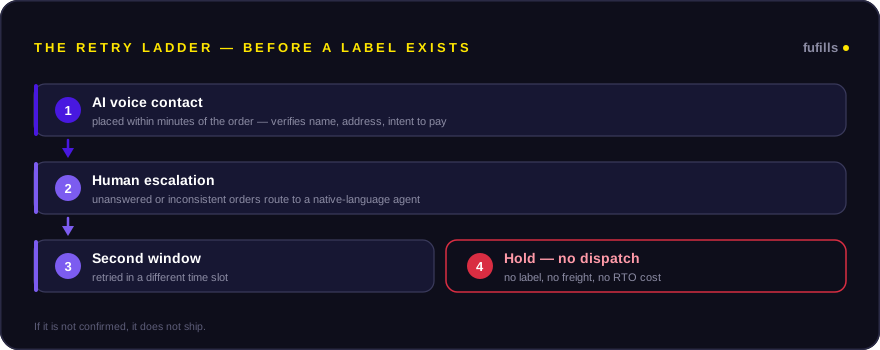
For merchants selling in Latin America, effective 3PL Mexico services are essential for scaling cash-on-delivery (COD) operations. The COD Operating System enforces Confirm → Dispatch → Deliver → Collect → Transfer gates. Without hard-gated confirmation enforced pre-dispatch, RTO rates spike above 30%,the hard gate is what stops bad orders before warehouse labor costs accumulate. Fufills operates in 10 fully operational LATAM markets with hubs (Mexico, Guatemala, Honduras, El Salvador, Nicaragua, Costa Rica, Ecuador, Dominican Republic, Puerto Rico, and Argentina) plus 6 in active expansion (Panama, Colombia, Brazil, Peru, Chile, and Bolivia), standardizing COD execution across the region.
Which courier actually collects the cash matters: see the Mexican paqueterías with cash on delivery compared before signing a carrier contract.
A COD-native 3PL in Mexico must bundle four layers: pre-dispatch confirmation (identity + address + payment readiness), warehousing near major distribution zones, multi-carrier routing with regional carrier selection logic, and COD reconciliation with USD settlement. Without confirmation, RTO rates exceed 30%; without USD settlement, FX exposure delays merchant payout 21+ days.
The term "3PL" (third-party logistics) covers a broad operational stack. In the Mexican COD market specifically, a functional 3PL provider must go well beyond simple pick-and-pack. The minimum viable service set for a COD-first merchant selling in Mexico includes:
- Inbound receiving and warehousing close to Monterrey, Guadalajara, or CDMX distribution hubs
- Multi-carrier last-mile routing that dynamically assigns carriers based on delivery zone, weight, and historical success rates
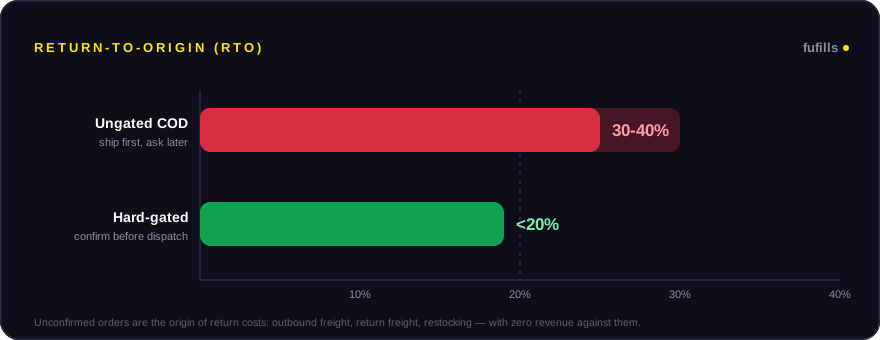
- Call-center order confirmation to verify buyer intent before dispatch-this single step drives RTO rates below 20%
- Merchant payout infrastructure that converts COD collections into USD and settles within a predictable window
Fufills bundles all four into one platform, accessible through our COD fulfillment overview. Merchants who use fragmented point solutions-separate warehousing, a standalone carrier, and manual confirmation-typically see RTO rates above 35% and cash-flow delays of 21 days or more.
COD in Mexico operates differently from card-based ecommerce. The buyer pays the delivery agent in cash at the door. That cash must then flow back up through the carrier, get reconciled against the merchant's order manifest, and finally be converted and remitted. Each handoff is a leak point.
Fufills' three-jurisdiction settlement structure-anchored by FUFILLS LLC in Wyoming (USA), FUFILLS LLC in Puerto Rico (USA), and FUFILLS SARL in Morocco-is designed specifically to compress this chain. The result is a 7-day USD settlement cycle, which gives Mexican COD merchants working capital that competes with card-based sellers. For context, most independent carrier arrangements in Mexico settle in 21–30 days in local currency, versus Fufills' 7-day USD cycle, adding FX exposure on top of the delay.
For merchants scaling from a few hundred orders per month to several thousand, this settlement architecture is often the operational unlock that makes growth financially viable. This process ensures cashflow predictability, a critical factor for sustained growth in COD markets.
No single carrier covers Mexico uniformly. Urban zones in CDMX, Guadalajara, and Monterrey have dense carrier competition and strong delivery success rates. Semi-rural and rural zones in states like Oaxaca, Chiapas, or Guerrero require regional specialists or national carriers with rural network depth.
A credible 3PL Mexico services provider routes dynamically-assigning the carrier most likely to succeed for each specific postal code, not just the cheapest rate. Fufills' multi-carrier routing layer does this automatically at order creation, factoring in:
- Destination zone classification (urban, suburban, rural)
- Historical delivery success rate by carrier per zone
- Package dimensions and declared value
- Carrier capacity constraints on a given day
Merchants accessing our Mexico country operations page can see the carrier mix available by state. Skydropx and 99Minutos are carrier-native platforms optimized for single-country last-mile density; they do not integrate pre-dispatch confirmation or cross-border USD settlement.
Return-to-origin (RTO) is the defining cost problem in Mexican COD fulfillment. An unconfirmed order dispatched to an address that turns out to be wrong, unreachable, or a bad-faith purchase costs the merchant: the product's forward shipping, the return shipping, and the warehouse re-processing labor-typically $4–$9 USD per failed attempt depending on package weight and zone.
Fufills applies a hybrid AI/human confirmation call before any order leaves the warehouse. The confirmation agent verifies:
- Buyer identity and intent to purchase
- Delivery address accuracy (street, interior number, between-streets reference)
- Preferred delivery window
- Payment readiness (cash amount available)
This process drives confirmation rates to 92%, holding RTO under 20%,meaningfully below the 30–40% Mexican market average. Mexican COD merchants without pre-dispatch confirmation typically report RTO rates of 30–40%, per carrier feedback Fufills processes monthly. This hard-gated confirmation ensures that only validated orders are dispatched, protecting merchant margins.
For a merchant running 2,000 orders per month at an average order value of $35 USD, dropping RTO from 35% to under 20% translates to roughly 300 fewer failed deliveries per month-a direct cost avoidance of $1,200–$2,700 USD monthly before factoring in recovered revenue.
The market includes regional operators (Cubbo, Melonn, Kiki Latam), carrier-native 3PLs (Skydropx, 99Minutos), and full-stack COD platforms like Fufills. Each category has a different strength profile:
| Provider type | Warehousing | Last-mile | COD confirmation | USD settlement | LATAM market count |
|---|---|---|---|---|---|
| Carrier-native (Skydropx, 99Minutos)* | Limited | Strong | Rare | Rare | 99Minutos (Mexico), Skydropx (Mexico, Colombia) |
| Regional 3PL (Cubbo, Melonn, Kiki Latam) | Strong | Outsourced | Rare | Limited | Kiki Latam (operates 4 countries) |
| COD-stack (Fufills) | Strong | Multi-carrier | Native (92%) | 7-day USD | 10 operational + 6 expansion |
- Skydropx and 99Minutos optimize single-carrier density in 1–2 countries; they do not integrate pre-dispatch confirmation or cross-border settlement.
The decision framework comes down to three questions:
- What percentage of your Mexico revenue is COD? If it's above 40%, a COD-native stack pays for itself.
- What is your current RTO rate? If it's above 25%, confirmation is your highest-leverage intervention. Review our deep dive on hard-gated confirmation for details.
- How much FX risk can you absorb? If you're paying suppliers in USD, delayed MXN settlement creates margin compression.
Merchants who answer "high COD mix, high RTO, USD cost structure" to all three should evaluate Fufills' end-to-end services as the primary fit.
Mexico is frequently the first market for LATAM COD expansion, but it is rarely the last. Merchants who achieve product-market fit in Mexico typically move next into Central America (Guatemala, Honduras, El Salvador) or the Dominican Republic within 6–18 months.
Fufills operates in 10 fully live markets, and Argentina. An additional 6 markets-, and Peru-are in active expansion, scaling infrastructure through 2026. This matters operationally because:
- A single merchant account covers all 10 markets without re-contracting
- The same confirmation workflow and settlement cycle applies cross-border
- Inventory can be split across regional warehouses with unified reporting
For merchants who anticipate LATAM growth, starting with a 3PL provider that already operates the destination markets eliminates a painful mid-scale migration. Review the full market footprint on our LATAM countries page.
According to the World Bank's Logistics Performance Index, Mexico ranks among the stronger LATAM logistics markets, making it the natural anchor market before expanding into lower-infrastructure countries where a COD confirmation layer becomes even more critical.
In-house fulfillment in Mexico requires: a bonded warehouse lease, WMS software licensing, carrier contract negotiation with volume minimums, a call-center headcount for confirmation, and a finance function to manage COD reconciliation and FX conversion. A bonded warehouse lease in Mexico City runs $800–$1,200 USD/month; add 2 FTE confirmation call-center staff at $2,500–$3,500/month, plus WMS software ($500–$1,000/month) and carrier contract minimums (typically 500–1,000 shipments/month),total fixed-cost floor is $4,000–$5,700/month before a single order ships. Fufills' per-order variable cost structure eliminates this fixed-cost floor entirely for merchants under 5,000 monthly orders.
For most DTC or D2C brands under 10,000 monthly orders, this cost structure is prohibitive. The fixed cost base is too high relative to variable order volume, and the operational complexity requires senior logistics headcount that typically runs $3,000–$6,000 USD/month in total compensation.
Outsourcing to a 3PL like Fufills converts that fixed cost into a variable per-order rate that scales with revenue. There are no warehouse lease commitments, no WMS licensing fees, and no carrier minimum-volume penalties. The full services breakdown details how per-order costs are structured across fulfillment, confirmation, and last-mile.
What is the difference between a 3PL and a courier in Mexico COD?
A 3PL (third-party logistics) provider manages the full fulfillment stack: receiving inventory, warehousing it, picking and packing orders, arranging last-mile delivery, and handling returns. A courier only moves packages from point A to B. For COD merchants in Mexico, a 3PL that also handles order confirmation and USD settlement is a materially different service from a standalone courier.
What confirmation rate should I expect from a 3PL Mexico COD operation?
Confirmation workflows that skip address verification typically achieve 80–85%; Fufills' hybrid AI/human process (identity + address + payment readiness) reaches 92%.
How quickly do 3PL Mexico services pay out COD collections?
Settlement timelines vary significantly. Fufills settles in 7 days USD; independent carriers settle 21–30 days MXN, adding both delay and FX exposure.
Which LATAM markets can a Mexico-based 3PL also serve?
Fufills operates 10 LATAM markets with hubs; 6 additional markets are in active expansion (16 total coverage).
What is a typical RTO rate for COD shipments in Mexico without confirmation?
Unconfirmed COD dispatch in Mexico typically produces RTO rates between 30–40% depending on the product category and traffic source, based on industry observations. With Fufills' pre-dispatch confirmation protocol, the RTO rate falls under 20%, with multi-attempt delivery reducing failures further before a return is triggered.
How does multi-carrier routing work in Fufills' 3PL Mexico services?
At order creation, Fufills' routing engine evaluates the destination postal code, historical delivery success rate by carrier per zone, package dimensions, and carrier capacity. It then assigns the optimal carrier automatically. Merchants do not manage carrier relationships or negotiate rates individually-the routing layer handles both performance optimization and cost management.
What happens if a COD order fails confirmation or address validation?
If an order fails confirmation (identity mismatch, unreachable address, payment unavailable), it is held in warehouse pending merchant decision. No dispatch occurs without hard-gate approval. This prevents the RTO cost spiral.
