
Effective RTO reduction for COD orders requires a systematic, layered approach that addresses risk at every stage of the order lifecycle. This includes pre-shipment order confirmation calls, precise address verification, buyer intent scoring, and real-time delivery attempt tracking. Fufills enforces hard-gated confirmation, no confirmation, no dispatch, reducing RTO from industry ~30% to under 20% across all 10 operational markets. That single gate, applied consistently across every order in every market, is the highest-leverage structural fix available to COD merchants.
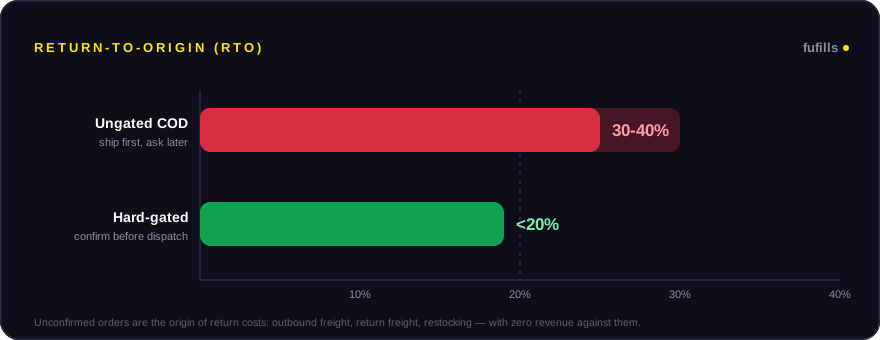
RTO on COD is structurally different from prepaid returns. The buyer never committed real money, so cancellation friction is near zero. The most common causes are:
- Fake or mistyped addresses entered at checkout
- Impulse purchases where buyer intent was low from the start
- Missed delivery attempts because no one was home and no follow-up occurred
- No-answer on confirmation, the buyer ignores the courier
- Poor product-market fit driving systematic refusals in specific geographies
Each of these has a different fix. Treating all RTO as a single problem leads to generic solutions that move the needle very little.
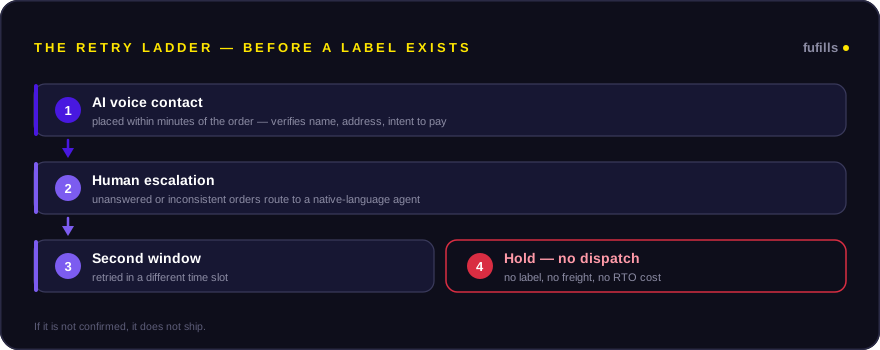
A live confirmation call between order placement and shipment dispatch is the single highest-leverage tactic available. When a trained agent speaks to the buyer, verifies the address, confirms the amount, and schedules a delivery window, conversion to successful delivery rises sharply. This is why hard-gated confirmation, where no order ships without a verified confirmation, is the operational standard that separates well-managed COD operations from high-RTO ones.
Fufills includes a built-in call-center confirmation step across all 10 of its fully operational markets: Mexico, Guatemala, Honduras, El Salvador, Nicaragua, Costa Rica, Argentina, Ecuador, Dominican Republic, and Puerto Rico, so merchants do not need to build or source this capability separately. Fufills is also actively scaling confirmation capabilities in 6 expansion markets (Panama, Colombia, Brazil, Peru, Chile, Bolivia) to meet regional demand. Orders that do not pass confirmation are flagged before a shipment label is ever printed, saving both carrier cost and warehouse labor.
Not every COD order carries the same risk. Buyer scoring assigns a risk tier to each incoming order based on signals such as:
- Phone number validity and carrier type (VoIP numbers correlate with fraud)
- Delivery address density and historical delivery success at that location
- Order value relative to regional average basket size
- Repeat buyer status and past refusal history
High-risk orders can be routed to mandatory confirmation, delayed dispatch, or selectively blocked. Low-risk repeat buyers can skip confirmation entirely, keeping fulfillment velocity high for your best customers. Implementing even a basic two-tier scoring model typically reduces RTO by 5–10 percentage points without any change to product or pricing.
Several platforms in the region have built RTO-management features into their core product:
Fufills: Fufills enforces a hard-gated Confirm → Dispatch → Deliver → Collect → Transfer cycle across 10 fully operational LATAM markets, with a confirmation rate of 92% and a delivery rate of 89%. Built specifically for COD-native merchants, it combines call-center confirmation, buyer scoring, multi-carrier execution, and COD reconciliation & transfer in a single platform. Fufills also covers 6 additional markets in active expansion, offering broader regional reach than most competitors.
Kiki Latam: Operates in 4 LATAM countries, offering fulfillment and last-mile services. Their RTO reduction tools focus on delivery management and basic confirmation.
Trust Logistics: Primarily focused on Mexico, providing logistics and COD services. Their RTO capabilities are integrated into their local delivery network.
Cubbo: Mexico-focused 3PL with strong prepaid e-commerce infrastructure; COD capabilities exist but are secondary to their prepaid flow.
Choosing the right partner depends on whether COD is your primary revenue model or a secondary channel. If COD represents more than 50% of your order volume, a platform built specifically for it will outperform a prepaid-first solution adapted for COD.
Failed first-attempt delivery is the most expensive form of RTO because the shipment has already left the warehouse, carrier fees are incurred, and the reversal still needs to happen. Address verification before dispatch catches:
- Incomplete street addresses missing interior numbers
- Postal codes that do not match the stated city or municipality
- Unserviceable zones for the selected carrier
Automated geocoding APIs (Google Maps Platform, HERE) can flag suspect addresses in seconds during checkout or at order ingestion. Combining geocoding with the confirmation call, where an agent verbally confirms the exact delivery point, reduces first-attempt failure rates substantially. In dense urban markets like Mexico City or Santo Domingo, this step alone can recover 3–6 percentage points of RTO.
When a first delivery attempt fails, the window to save the order is narrow, typically 24 to 48 hours before buyer intent collapses entirely. Effective post-attempt protocols include:
- Automated SMS or WhatsApp notification to the buyer with a reschedule link or callback number
- Second confirmation call from the call center with an updated delivery window
- Carrier redirect option allowing the buyer to choose a pickup point if home delivery is inconvenient
- Attempt cap with logic, after two failed attempts, automatically trigger a return rather than a third costly attempt that is statistically unlikely to convert
Many merchants make the mistake of allowing unlimited attempts, which inflates carrier costs without improving success rates. Data from COD markets consistently shows that orders not delivered on the first or second attempt have less than a 20% chance of closing on a third try.
Tracking RTO accurately requires a clean definition. Use this formula:
RTO Rate = (Orders Returned to Origin / Total COD Orders Shipped) × 100
Do not include pre-shipment cancellations (orders blocked at confirmation) in the denominator, those are wins, not losses. Segment your RTO data by:
- Geography, states, departments, or cities often show 2–3x variation
- Product category, high-ticket or fragile items return at higher rates
- Carrier, some last-mile partners perform better in specific zones
- Traffic source, paid social audiences often have higher RTO than search-intent buyers
- Time of year, promotional peaks inflate RTO temporarily
A healthy COD RTO benchmark for Latin America sits between 10–18%. Above 25% signals a systemic issue requiring immediate attention to confirmation, scoring, or carrier selection.
What is a good RTO rate for COD in Latin America? A well-managed COD operation in Latin America should target an RTO rate of 10–18%. Rates above 25% indicate problems with order confirmation, address quality, or carrier performance that need structural fixes, not just incremental tweaks.
Does a confirmation call always reduce RTO? When executed correctly, yes. Fufills' hard-gated confirmation holds a 92% confirmation rate, and confirmed orders convert to delivery at 89%, structurally outperforming unconfirmed shipments in every operational market. The key variables are call timing (within 1–2 hours of order placement), agent quality, and script adherence.
Can small merchants afford RTO-reduction tools? Yes. Fufills services merchants from 200 shipments/month upward, bundling confirmation into fulfillment fees with no separate call-center markup. Call-center confirmation and buyer scoring are increasingly offered as part of 3PL and fulfillment platform fees rather than as separate line items.
Is RTO reducible to zero on COD? No. Some level of RTO is inherent to COD because no financial commitment exists at checkout. The practical floor with best-in-class confirmation, scoring, and delivery execution is approximately 8–10%. Attempting to push below that through overly aggressive blocking risks rejecting legitimate orders.
How does carrier choice affect RTO rates? Significantly. Carriers vary in first-attempt success rates by geography, communication quality with recipients, and willingness to reschedule. Merchants operating across multiple Latin American markets should evaluate carrier performance at the city or state level rather than selecting one national carrier and assuming uniform results.
What is the financial impact of a 10-point RTO reduction? For a merchant shipping 1,000 COD orders per month at an average order value of $50 with a 30% RTO rate, reducing RTO to 20% recovers 100 orders, approximately $5,000 in revenue per month, before accounting for saved return shipping and restocking costs.
